Paige Bueckers holding court at Dallas Wings Media Day in Arlington, Texas. The sophomore point guard’s refined perimeter game and pick-and-roll mastery have fueled the Wings’ 2026 breakout. (Photo: Mason Garcia | The Podium Finish)
ARLINGTON, Texas — Amid the noise surrounding off-court narratives, Dallas Wings guard Paige Bueckers is quietly assembling one of the strongest sophomore campaigns in the WNBA in recent years. A year removed from carrying a 10-34 rebuilding team to a Rookie of the Year campaign, Bueckers has transformed herself into one of the league’s most complete players and a legitimate Most Valuable Player candidate.
Her transformation is rooted in technical refinement, a shift to primary point guard duties and a dynamic frontcourt partnership with power forward Jessica Shepard.
From Lone Bright Spot to Point Guard Wunderkind
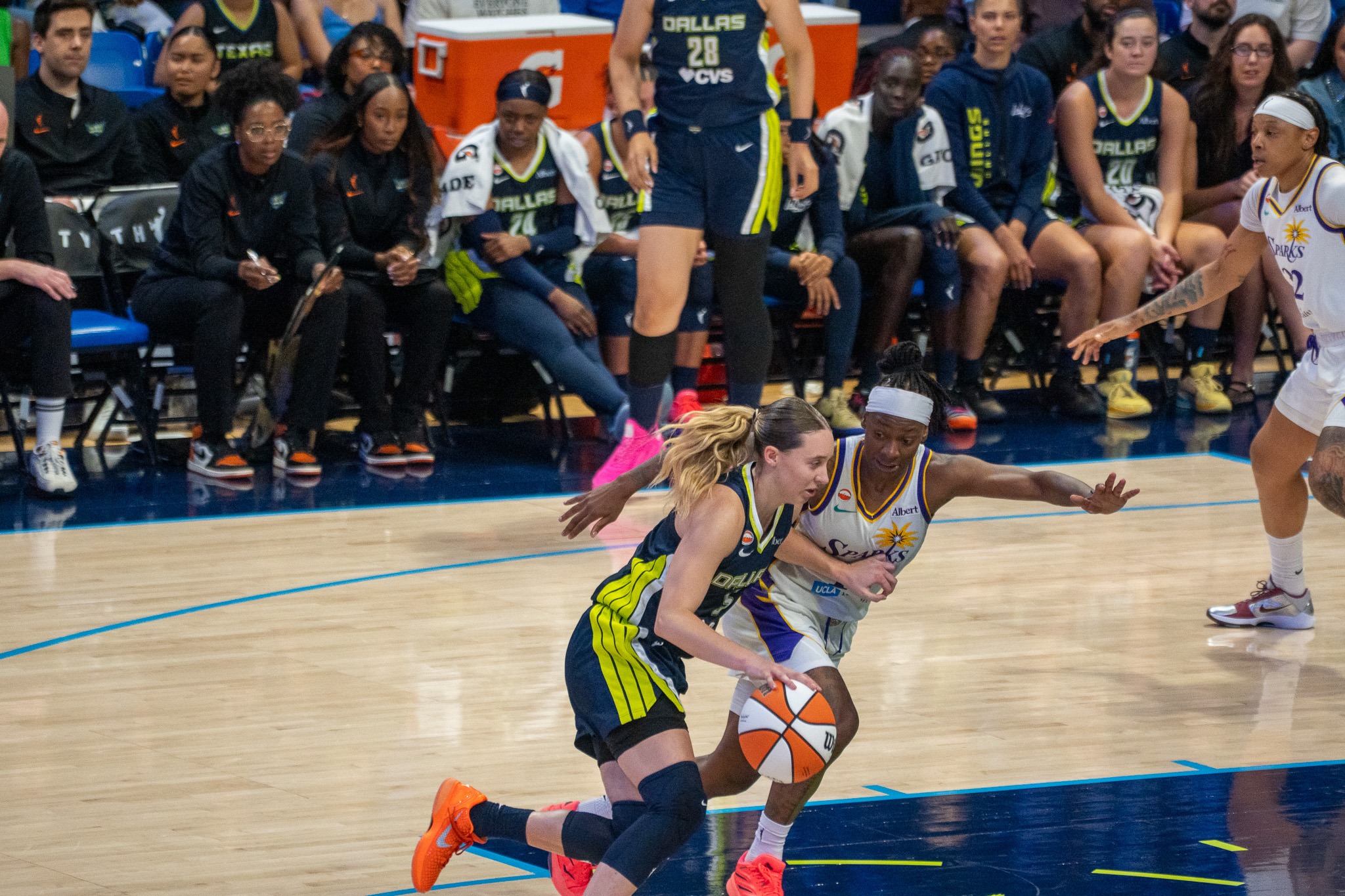
Dallas Wings guard Paige Bueckers (5) drives downhill against the Los Angeles Sparks defense. Bueckers’ shift to primary point guard duties in 2026 has transformed Dallas into a high-powered pick-and-roll offense. (Photo: Mason Garcia | The Podium Finish)
During her rookie season, Bueckers averaged 19.2 points, 3.9 rebounds and 5.4 assists per game. While impressive, her usage was often reactionary, taking place on a roster struggling for offensive identity. In 2026, her traditional production has surged to 20.9 points, 4.2 rebounds, and 6.2 assists per game, but the raw box score tells only part of the story.
The primary catalyst behind Bueckers’ evolution has been her full-time transition to primary point guard. Operating as Dallas’ primary point guard, Bueckers has reshaped the Wings into a downhill, pick-and-roll force.
Advanced tracking metrics highlight her ability to dictate pace and space. In a July 10 victory over the Toronto Tempo, Bueckers generated an offensive rating of 138.7 over 38 minutes while posting 34 points and six assists. Her manipulation of defenders out of screen action was on full display.
When asked postgame about countering Toronto’s aggressive perimeter pressure, Bueckers smiled, recognizing the precise tactical breakdown: “I mean, you said it. You saw the game. But my teammates just did a really good job of screening for me, holding screens, letting me get to an advantage and playing in space. And then we just did a good job moving the ball, not getting stagnant.”
Her mastery of hostage and snake dribbles has turned mid-range coverage into a tactical liability for opponents. By keeping defenders attached to her back hip out of high pick-and-rolls, Bueckers consistently creates a two-on-one advantage that forces difficult decisions from opposing defenses.
When defenders attempt to top-lock or overplay the screen, she is equally comfortable rejecting it, attacking the inside shoulder of her defender or patiently keeping the opposing center in drop coverage until help rotates. Those reads allow her to manipulate the low-man defender before threading pocket passes to rolling bigs or finding open shooters around the perimeter.
The result is an offense that rarely settles for contested shots, forcing defenses to navigate multiple actions within the same possession.
Off-Ball Lethality and Perimeter Versatility
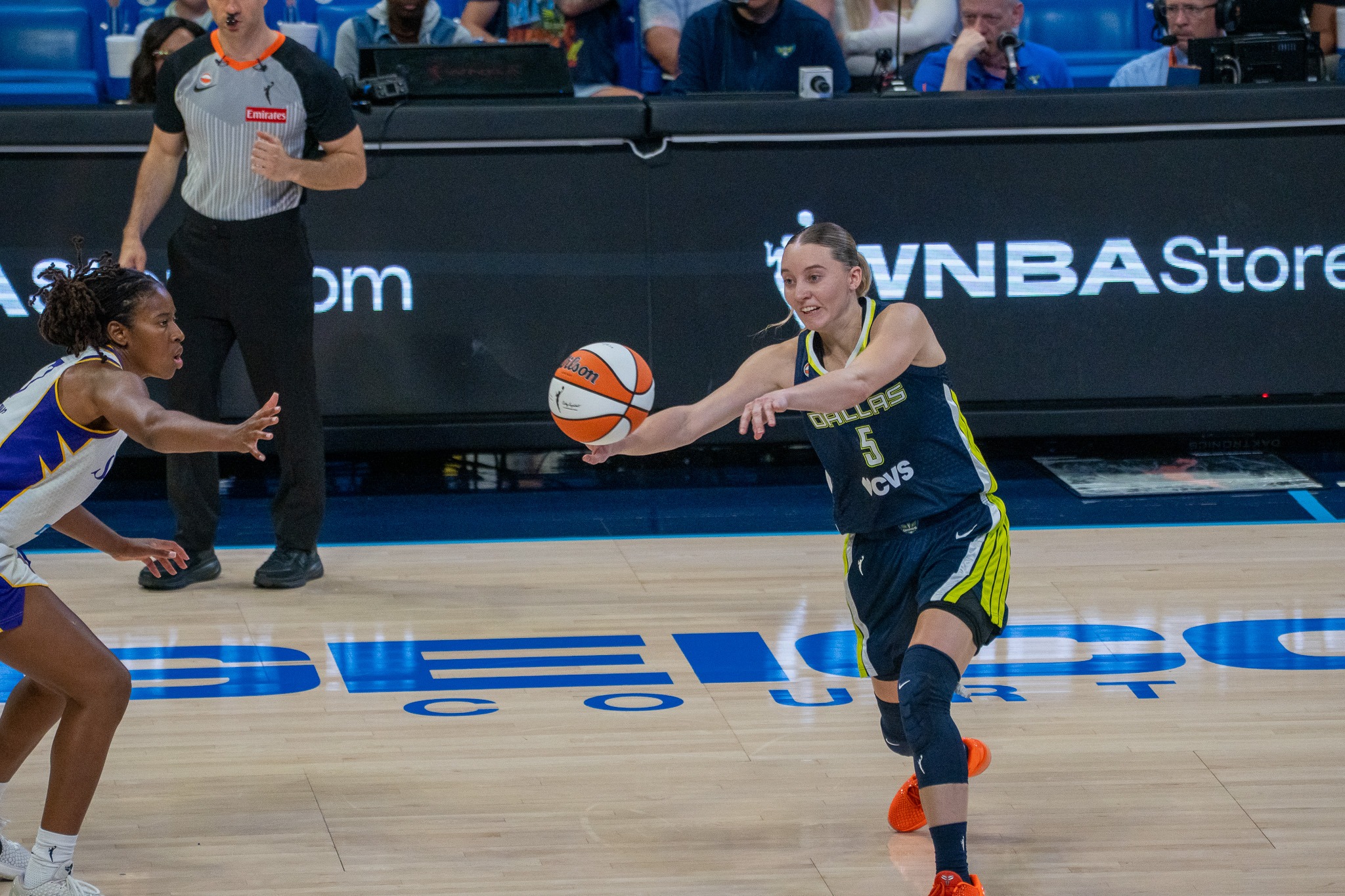
Paige Bueckers (5) fires a pass past a Los Angeles Sparks defender during a 2026 regular season matchup. Bueckers tied the Wings’ single-game franchise assist record with 14 dimes against L.A. on June 5. (Photo: Mason Garcia | The Podium Finish)
While Bueckers’ on-ball vision has elevated Dallas, her off-ball movement marks her biggest area of growth since 2025. Last season, her off-ball possessions occasionally stalled when defenses loaded up on her. In 2026, her perimeter actions are relentless.
Whether curling off pin-downs or running baseline tracks, she constantly forces defensive rotations. Against the Indiana Fever on May 9, she shot 80 percent from the field in 32 minutes while recording a true shooting percentage of 79.1 percent. Her ability to score efficiently without dominating possession time allows the dynamic Arike Ogunbowale and young core pieces like Azzi Fudd to operate inside their natural rhythm.
That off-ball balance was evident on June 5 against the Los Angeles Sparks, where Bueckers tied the Wings’ single-game franchise assist record with 14 dimes while committing just one turnover.
“My teammates just did a really good job of getting people open, of screening, of cutting, of moving without the ball, and just making the game easy for me,” Bueckers noted in the press room after the game. “Assist means just giving to your teammates, so that’s really the best accomplishment you can give.”
Even when opponents attempt to throw multiple bodies at her to force the ball out of her hands, Bueckers leverages the attention to unlock the rest of the roster. Addressing how she handled Minnesota’s defensive traps during a June 28 matchup, she explained: “Just seeing a lot of bodies, a lot of footing to the ball. So to be able to get out of it, play to the advantages that it creates for my teammates… getting them in scramble mode, getting them in closeout mode so we can attack closeouts and get to the paint, get paint touches and sprays.”
The Anchor: Jessica Shepard and Systemic Balance
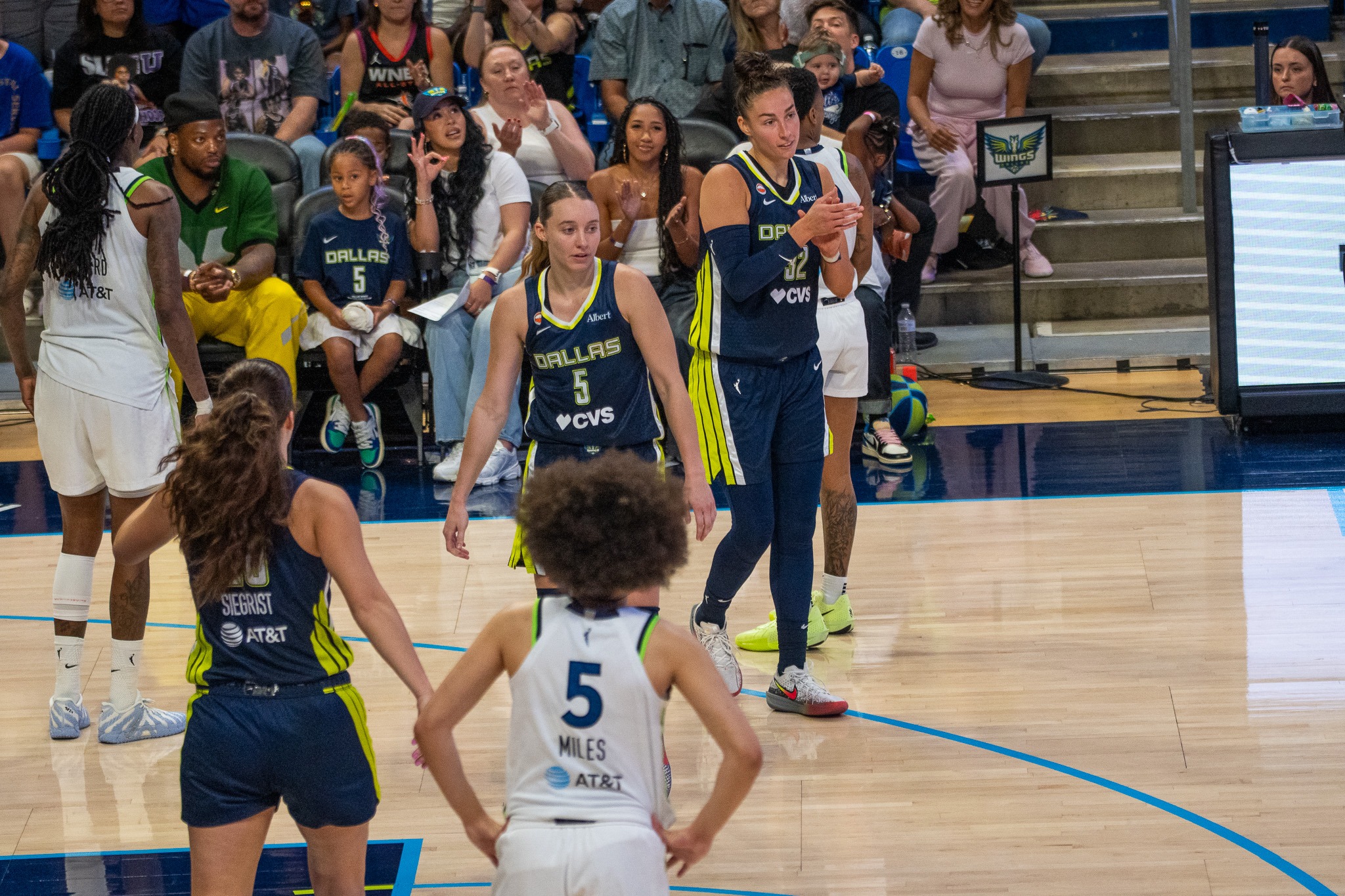
Dallas Wings forward Jessica Shepard and guard Paige Bueckers on the hardwood during a game against the Minnesota Lynx. The dynamic partnership between Bueckers and Shepard has provided Dallas with a dual-facilitator attack in 2026. (Photo: Mason Garcia | The Podium Finish)
Bueckers’ individual brilliance has been further elevated by the addition of Shepard. Dallas’s offensive ecosystem no longer depends solely on Bueckers creating advantages from the perimeter. Shepard’s ability to rebound, initiate offense and function as a connective passer gives the Wings a second decision-maker, preventing defenses from loading every possession toward Bueckers.
Shepard’s interior presence and rebounding dominance give Dallas an elite interior anchor. Through the 2026 season, Shepard has notched four triple-doubles alongside routine double-double efforts, giving the Wings a unique playmaking hub in the frontcourt.
When Shepard grabs defensive rebounds and pushes the break or operates out of the high post, Bueckers is freed to run the floor as a transition threat. The dual-facilitator dynamic between Bueckers and Shepard spreads out opposing defenses, allowing young perimeter players like Fudd and Aziaha James to thrive in secondary actions.
During a July 2 victory over the Connecticut Sun, Bueckers delivered a late-game masterpiece, scoring 11 unanswered points in the fourth quarter to cap off a 25-point, seven-rebound, seven-assist stat line while generating a +22.7 Net Rating.
Reflecting on her growth through high-pressure fourth quarters, Bueckers pointed to the collective execution of the group: “My teammates did a really good job of screening for me, getting me open off of ball screens, getting me open in transition, good play calling by the coaching staff, and just trying to be aggressive, read what the game is calling for.”
A Wunderkind Execution of Identity

Paige Bueckers (5) of the Dallas Wings has evolved her already efficient, multi-faceted play on the hardwood. (Photo: Mason Garcia | The Podium Finish)
The difference between Bueckers’ 2025 rookie season and her 2026 sophomore execution comes down to control. In 2025, Dallas struggled to find rhythm, recording negative Net Ratings across majority stretches of the season. In 2026, Bueckers regularly anchors positive net differentials, including a +48.5 Net Rating performance against Toronto on July 5 and a +42.9 mark against Las Vegas on June 15.
Her improvements in shooting efficiency, true shooting percentage and assist-to-turnover ratio are the product of better reads, improved pacing and an advanced command of pick-and-roll coverage.
More impressively, she has maintained elite efficiency while assuming primary playmaking responsibilities, a balance few high-volume guards sustain over the course of a season.
Rather than sacrificing shot quality for increased offensive responsibility, Bueckers has elevated both her scoring efficiency and her ability to create quality opportunities for teammates. Combined with Shepard’s interior dominance, Bueckers has shifted the narrative surrounding the Dallas Wings from a long-term rebuild to an active contender.
As the second half of the 2026 season unfolds, the conversation surrounding Bueckers is no longer about whether she has become one of the WNBA’s brightest young stars. It is whether her blend of elite efficiency, playmaking and winning impact has elevated her into the center of the league’s MVP race.
MVP races are often defined by more than scoring totals. They reward players who consistently elevate everyone around them. Bueckers has done exactly that.
Her command of tempo, decision-making in pick-and-roll action and willingness to leverage defensive attention into opportunities for teammates have transformed Dallas from a rebuilding franchise into one capable of challenging the league’s best.