Paige Bueckers (5) of the Dallas Wings became the fastest WNBA player to score 1,000 career points and 250 career assists. (Photo: Dallas Wings)
SEATTLE — The milestone arrived on a signature pull-up jump shot in the closing moments of overtime at Climate Pledge Arena. When the ball snapped through the net, it did more than just secure a critical late-game margin for the Dallas Wings against the Seattle Storm. It firmly established Paige Bueckers alongside the most prolific and versatile guards the WNBA has ever seen.
By reaching 1,000 career points in just her 52nd professional appearance, Bueckers tied former league MVP Elena Delle Donne as the fourth-fastest player in WNBA history to hit the milestone. The achievement puts her just one game behind elite company on her own roster, as teammate Arike Ogunbowale reached the mark in 51 games. It also places her alone in the record books as the fastest player in WNBA history to couple 1,000 career points with 250 assists.
The achievement anchors an increasingly dominant sophomore campaign for Bueckers, who scored 17 of her 27 points in the fourth quarter and overtime to lift Dallas to a 112-110 victory. Coupled with a dramatic, last-second comeback victory over the Chicago Sky on Saturday night, the performance highlights a player whose late-game composure matches her historic statistical pace.
Navigating the Friction of Professional Growth
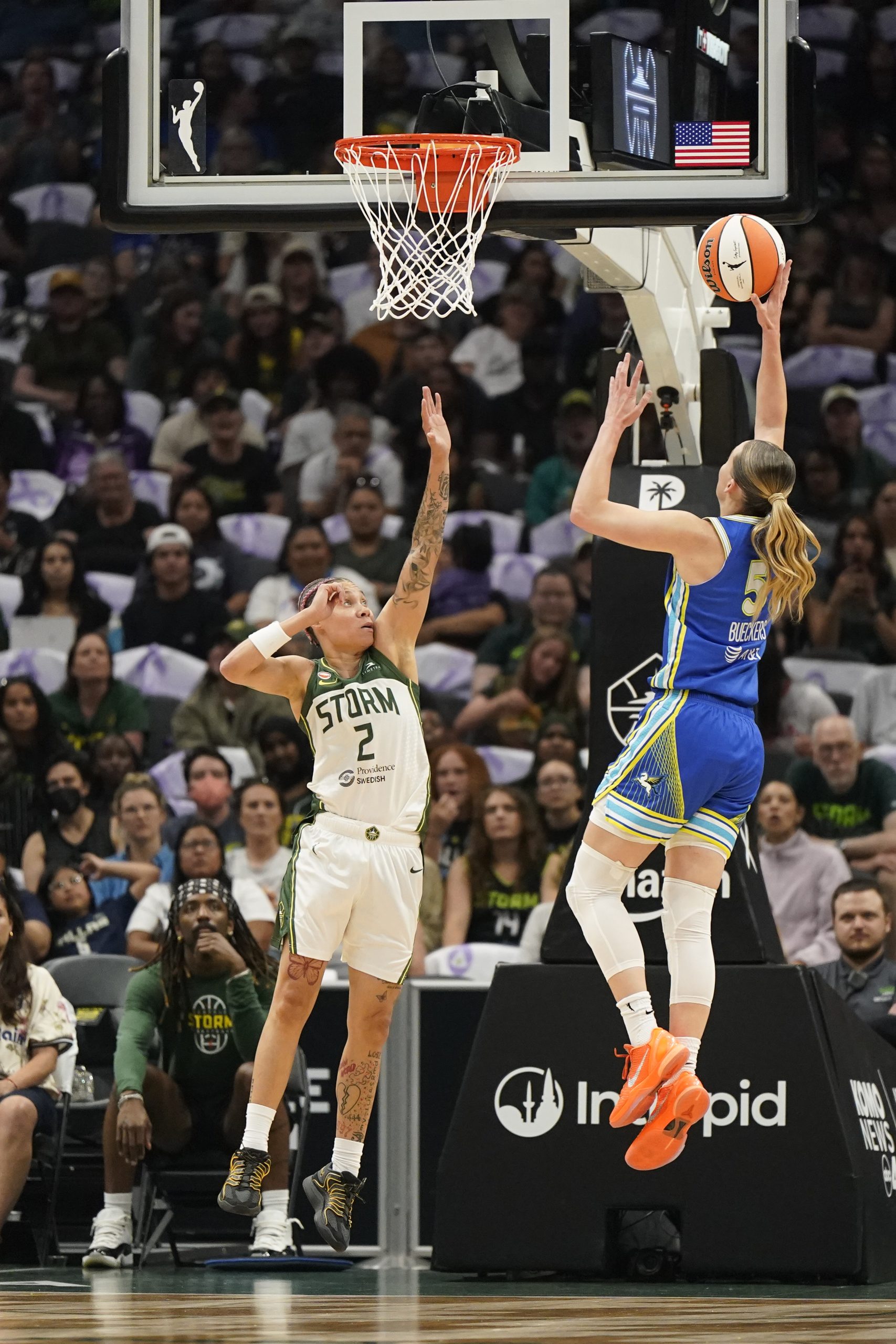
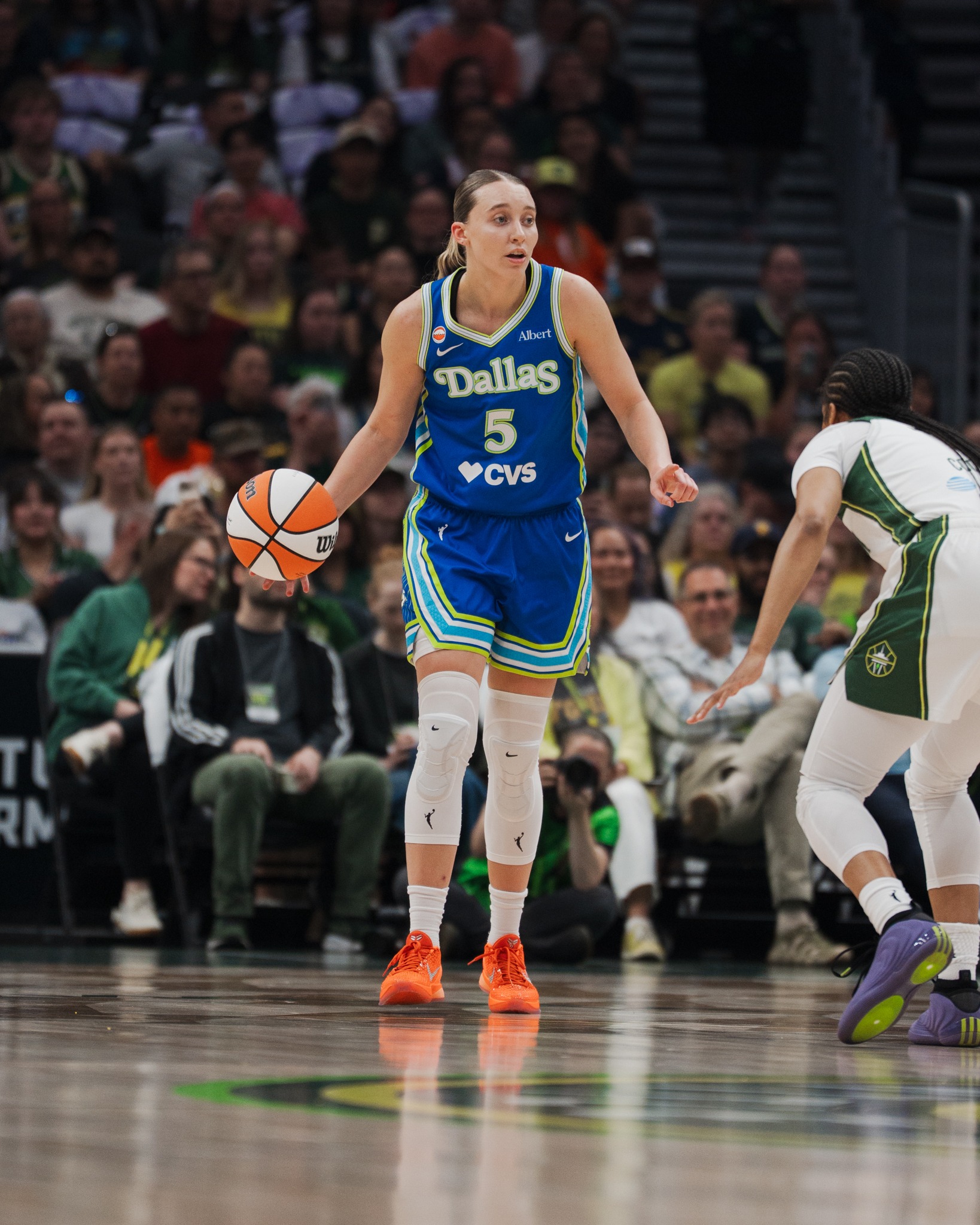
SEATTLE, WA – JUNE 22: Paige Bueckers #5 of the Dallas Wings drives to the basket during the game against the Seattle Storm on June 22, 2026 at Climate Pledge Arena in Seattle, Washington. NOTE TO USER: User expressly acknowledges and agrees that, by downloading and or using this photograph, User is consenting to the terms and conditions of the Getty Images License Agreement. Mandatory Copyright Notice: Copyright 2026 NBAE (Photo by David Ryder/NBAE via Getty Images)
To understand the speed of Bueckers’ ascent to 1,000 points, one must look at the foundation built during her 2025 WNBA Rookie of the Year campaign. She compiled 692 points during her introductory season, blending an efficient perimeter game with an elite ability to navigate screens.
As defensive coverages have intensified during her second year, her approach to the game has adjusted. Teams frequently throw physical traps and secondary defenders along the perimeter to disrupt her rhythm. When individual looks become scarce, Bueckers emphasizes that her responsibility shifts toward finding alternative avenues to control the outcome of the game.
“Try to affect the game in other ways,” Bueckers said when discussing her approach during challenging offensive stretches. “Try to be better defensively, maybe rebound more, get my teammates open a little bit more. And just have positive self-talk. We work so hard in this sport, and some nights it is not your night shooting the ball, but until the buzzer sounds, things can always change.”
That defensive emphasis materialized in the victory over Seattle, where Bueckers logged five rebounds and five assists to balance her scoring load. Her willingness to facilitate allowed backcourt partner Azzi Fudd to flourish, opening up space for Fudd to finish with a career-high 26 points. The offensive spacing created by Bueckers’ perimeter gravity consistently put the Seattle defense into recovery rotations.
Tactical Shifts Unlock Perimeter Dominance
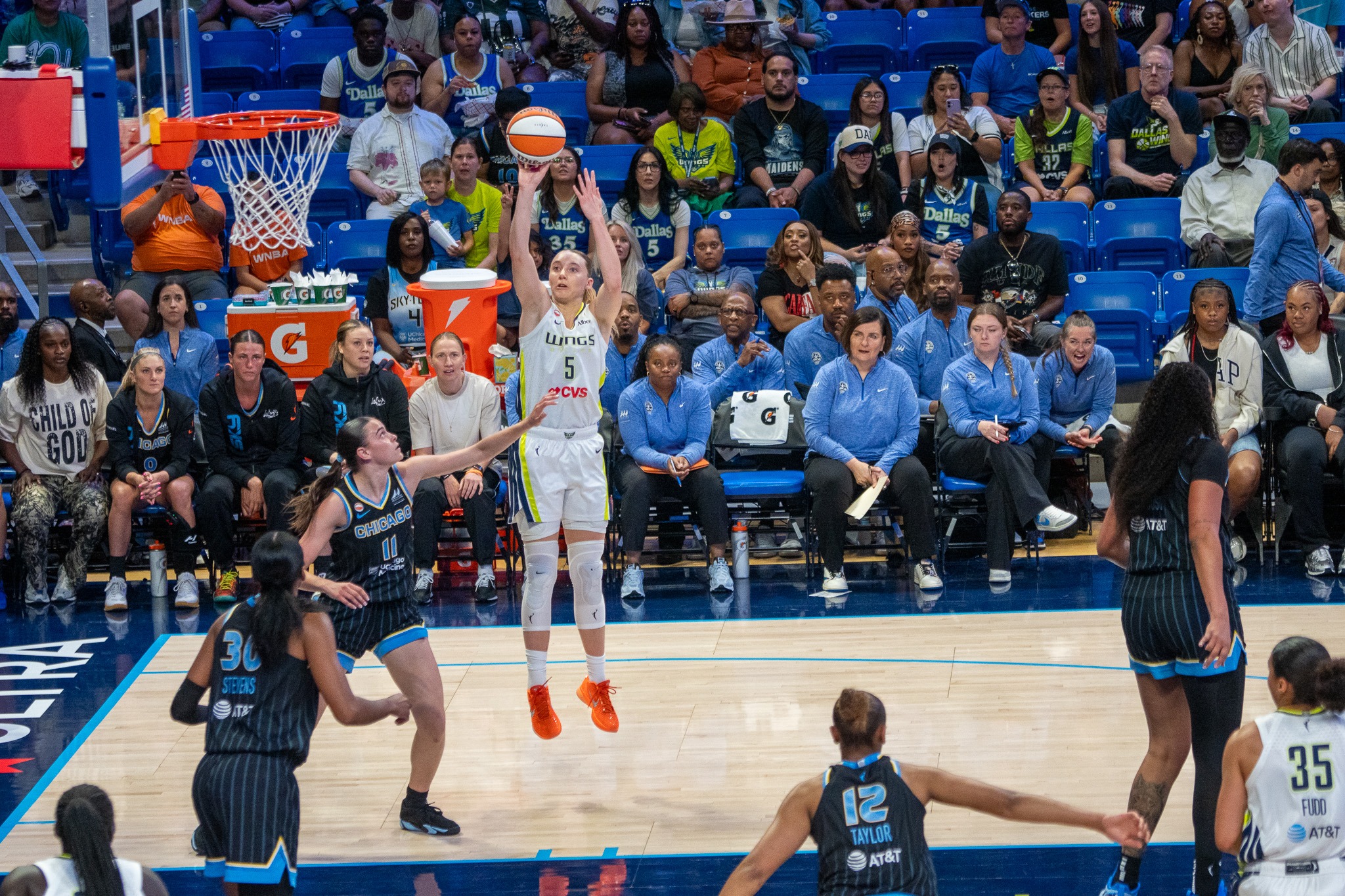
Paige Bueckers (5) of the Dallas Wings has made the art of the middy into an essential in the game of basketball. (Photo: Mason Garcia | The Podium Finish)
The schematic adjustments deployed by Dallas in late-game situations have played a critical role in unlocking Bueckers’ efficiency. Opposing defenses routinely try to force her into head-on, isolation situations where her lack of elite straight-line speed can stall the offense.
To counteract this, Dallas has increasingly relied on running staggered drag screens during fourth-quarter stretches. The design initiates with the first drag screen set early ahead of midcourt on the backcourt side. A second drag screen is then immediately established above the top of the key.
This specific sequence allows Bueckers to build downhill momentum and attack the defense at a distinct angle while keeping her primary defender in a trail position. When attacking from the slot via these angles, her mid-range package becomes nearly impossible to contain. Her shoulder-roll, reverse spin into a fadeaway jumper is incredibly difficult to contest, as is her standard crab-dribble pull-up.
Furthermore, deploying the double drag allows Fudd and Ogunbowale to execute staggered cross-lifts along the perimeter. This movement successfully clears out the slot, giving Bueckers a clear runway to either drive deep into the lane or manipulate the defense from the elbow.
Sustaining Resilience Under High Pressure
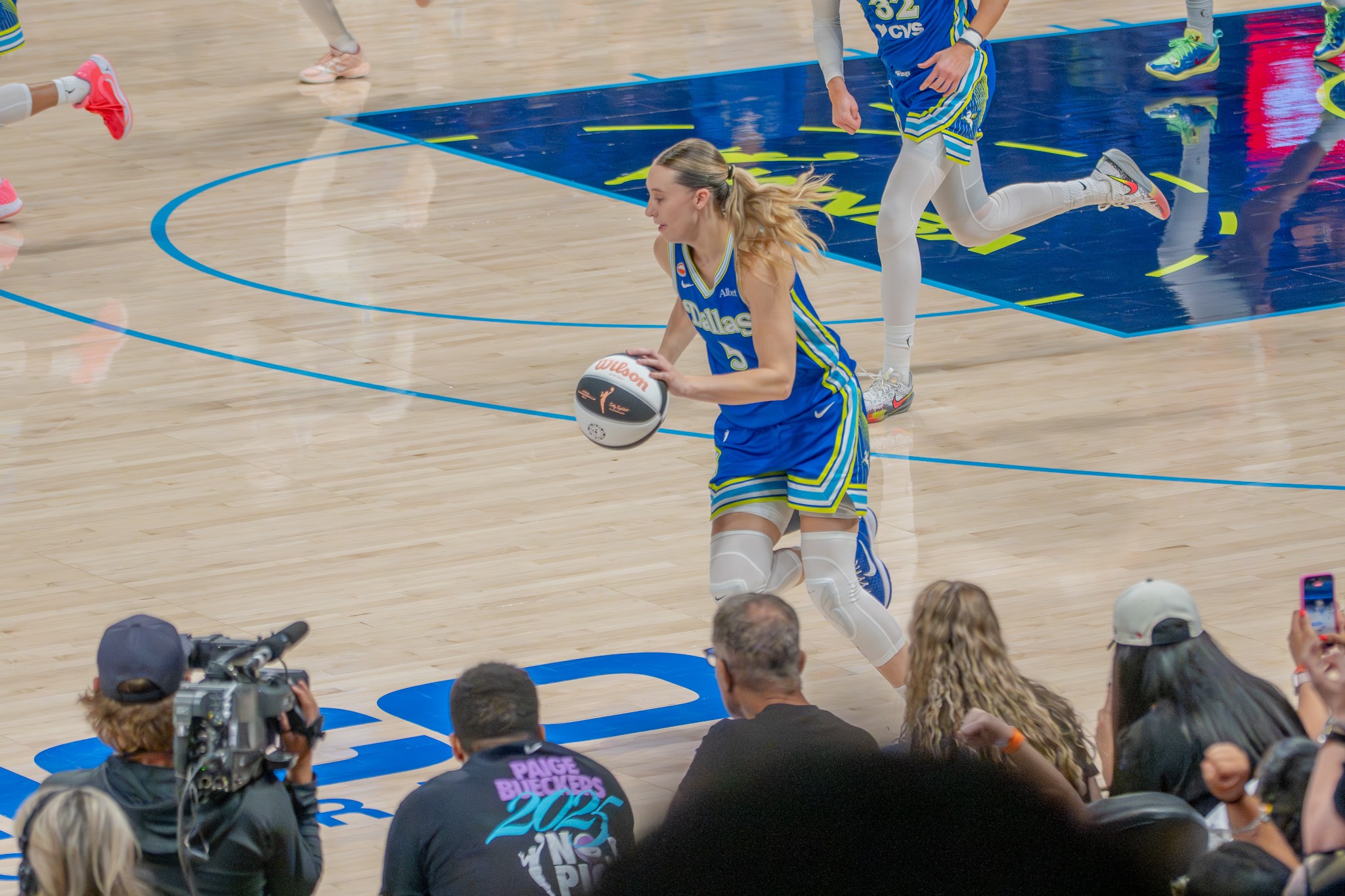
Paige Bueckers (5) of the Dallas Wings has proven herself to handle high pressure situations with confidence. (Photo: Mason Garcia | The Podium Finish)
The milestone night in Seattle followed a familiar script for a Dallas team that has developed a reputation for late-game rallies. Against Chicago, the Wings erased a 14-point deficit after a crucial fourth-quarter coach’s challenge completely altered the momentum of the game.
Rather than looking for low-probability, quick-strike plays when facing large deficits on the road, Bueckers notes that the team’s internal communication emphasizes incremental progress. The objective focuses on stacking successful defensive possessions back-to-back to unlock transition opportunities.
“We always felt like we were in it, and we were scrapping and fighting,” Bueckers said regarding the team’s mindset when playing from behind. “And we started to get some stops and string together some stops. And we got out in transition a little bit more.
“We got them in foul trouble. I think we got them in the bonus with like five minutes left. So we were just trying to attack that way, and just chip away. Not hit any home runs, but one possession at a time. Dig in defensively, get what we want, and execute offensively.”
That exact patience dictated the final moments against the Storm. Trailing late in regulation, Dallas avoided rushed perimeter looks. Instead, Bueckers hit consecutive 3-pointers to erase a late six-point deficit before executing a 12-foot turnaround fadeaway jump shot with six seconds left to force the extra period.
The Chemistry of a Storied Backcourt
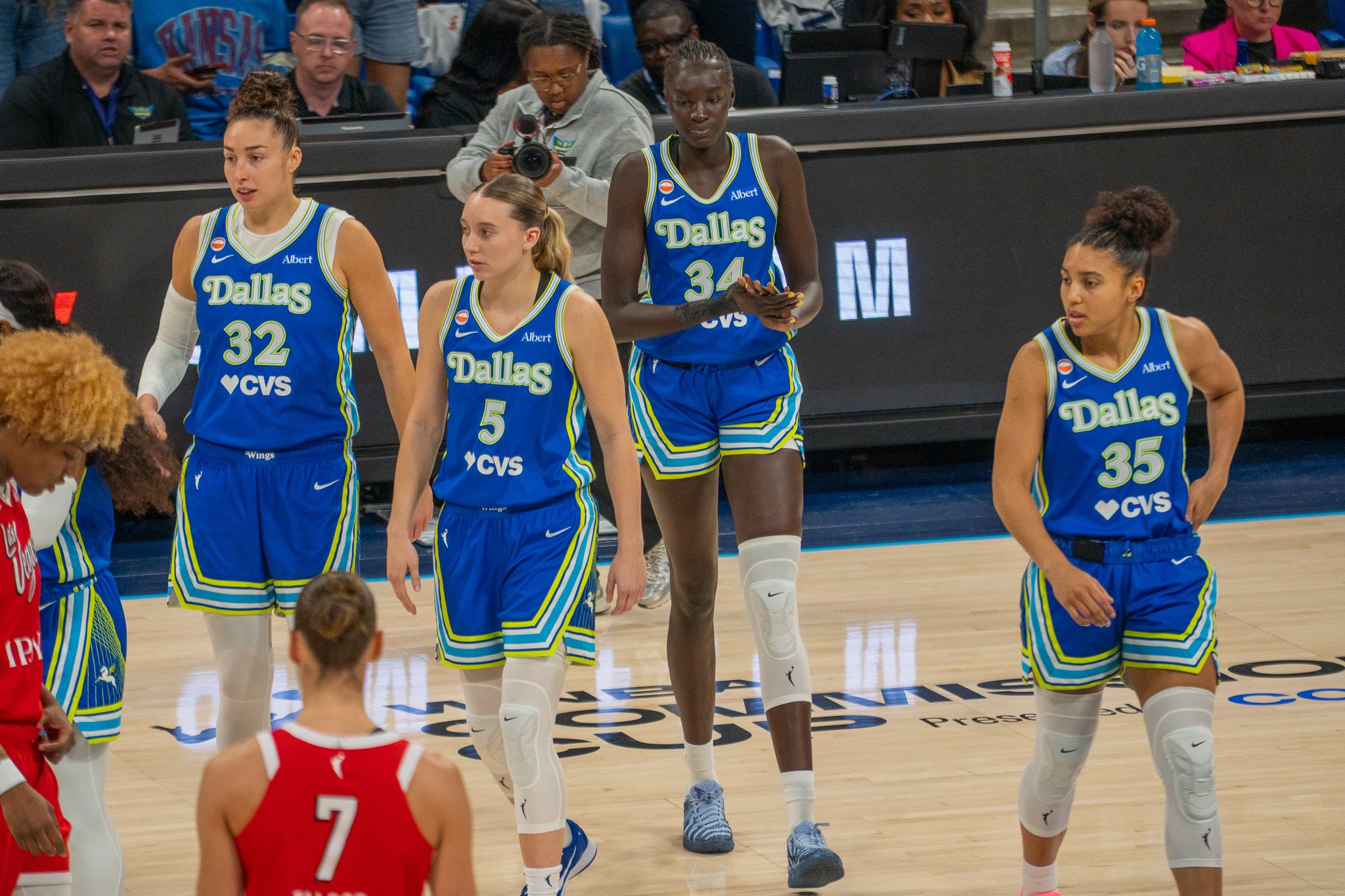
Paige Bueckers and her Dallas Wings teammates, including Jessica Shepard (32), Awak Kuier (34) and Azzi Fudd (35) have redefined the team’s trajectory and culture. (Photo: Mason Garcia | The Podium Finish)
The translation of collegiate chemistry to the professional level has provided Dallas with one of the most dynamic backcourt combinations in the league. The partnership between Bueckers and Fudd allows the Wings to run intricate dual-screen actions, forcing opposing defenses to make rapid switching decisions.
When Seattle focused its interior attention on slowing down center Dominique Malonga, who finished with a game-high 37 points, the Dallas guards seized control of the perimeter. Fudd’s aggressive driving lanes directly complimented Bueckers’ mid-range spacing.
The ability to execute under duress relies on absolute clarity during huddles when noise levels rise in hostile road environments. Bueckers pointed out that maintaining constant huddling prevents execution errors when the game speeds up.
“Just keep huddling, keep having that constant communication of what we want,” Bueckers said. “And just to stick with it until the final buzzer. I think that is what you saw.”
The trust extends deeply into the depth of the roster. When teams adjust their schemes to limit Bueckers’ direct touches late in games, the secondary options must remain prepared. Against Chicago, it was a critical screen that freed up space for a game-winning attempt. In Seattle, it was Fudd converting a driving layup with 13 seconds left in overtime to put Dallas ahead for good.
Reflecting on the execution of those game-winning sequences, Bueckers credits the fundamental work done by her teammates away from the ball.
“Somebody sent me a great screen, and I saw a little bit of daylight,” Bueckers said of her late-game looks. “And so I knew it had to go up. So just having that confidence, my teammates doing a great job of getting me open, and then just trying to knock it down.”
Historical Context and the Road Ahead
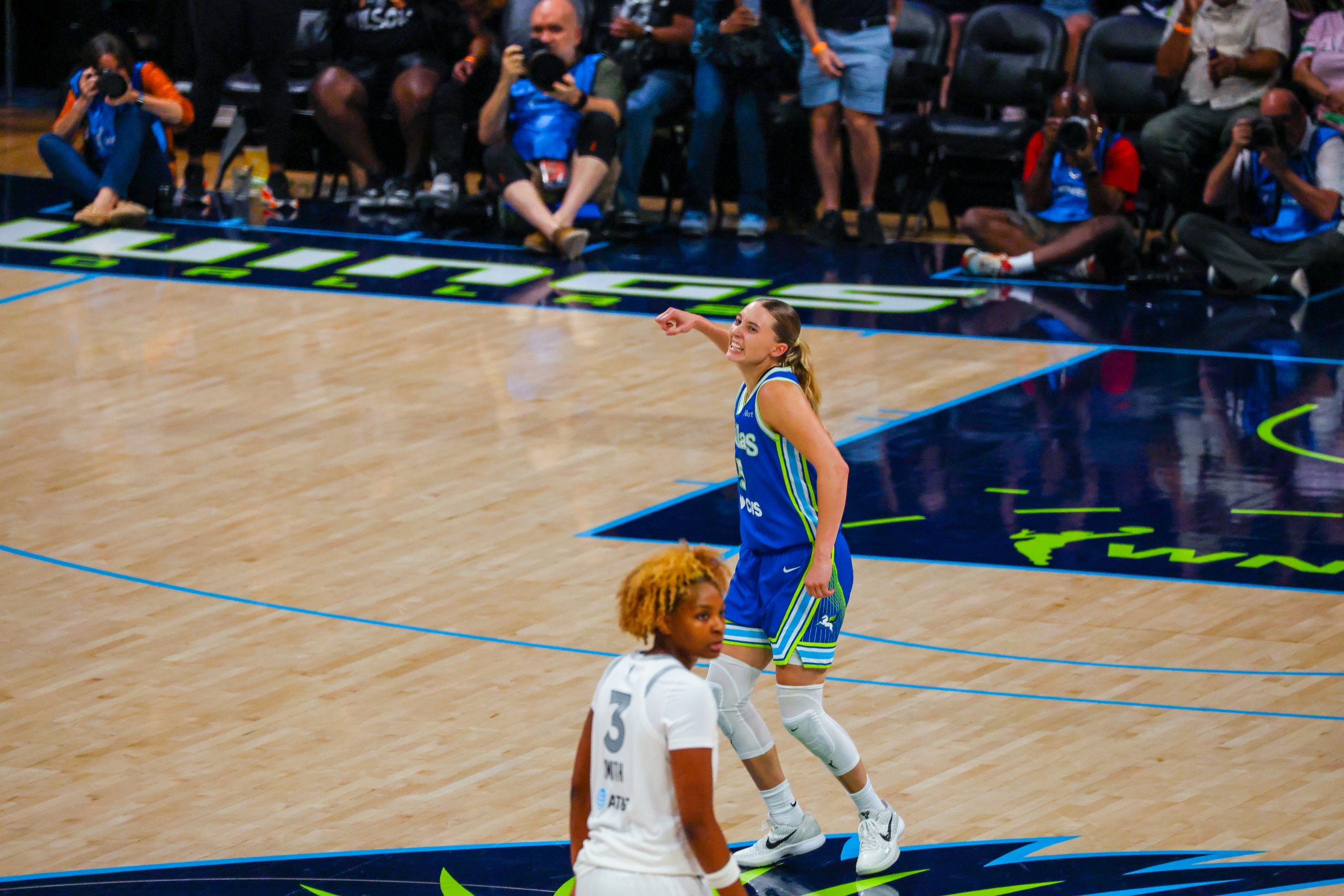
Paige Bueckers (5) of the Dallas Wings continues to evolve her game in her sophomore season. (Photo: Rachel Schouler | The Podium Finish)
Reaching 1,000 points in 52 games places Bueckers in a rare tier of historical efficiency. The modern game demands high-volume scoring combined with elite efficiency, a balance she has maintained while carrying a significant playmaking burden for Dallas.
Tying Delle Donne and sitting a lone game back of Ogunbowale underscores the rare territory Bueckers now occupies. Her new standard for the combination of 1,000 points and 250 assists highlights her unique identity as an offensive engine. She is not simply an isolated scoring threat, but a structural piece capable of elevating an entire franchise’s offensive ceiling through court vision.
As the WNBA calendar progresses through a demanding 44-game regular season schedule, the focus for Dallas shifts from celebrating individual milestones to addressing early-game consistency. The habit of falling into double-digit deficits before launching furious fourth-quarter comebacks remains an area the coaching staff intends to rectify.
Yet, having a primary scoring option who historical pacing suggests is only entering her prime provides the Wings with an enviable foundation. Bueckers’ blend of analytical efficiency, defensive engagement during shooting lulls, and late-game execution suggests that her first 1,000 career points are merely the introductory chapter of a prolonged historic run.
For Bueckers, the focus remains entirely structural rather than statistical. The milestone serves as validation of the developmental process, but the ultimate value of those 1,000 points lies in their direct contribution to a culture of winning under pressure.
Editor’s Note
Conrado Pascual, Managing Editor, Basketball, contributed to this feature story.