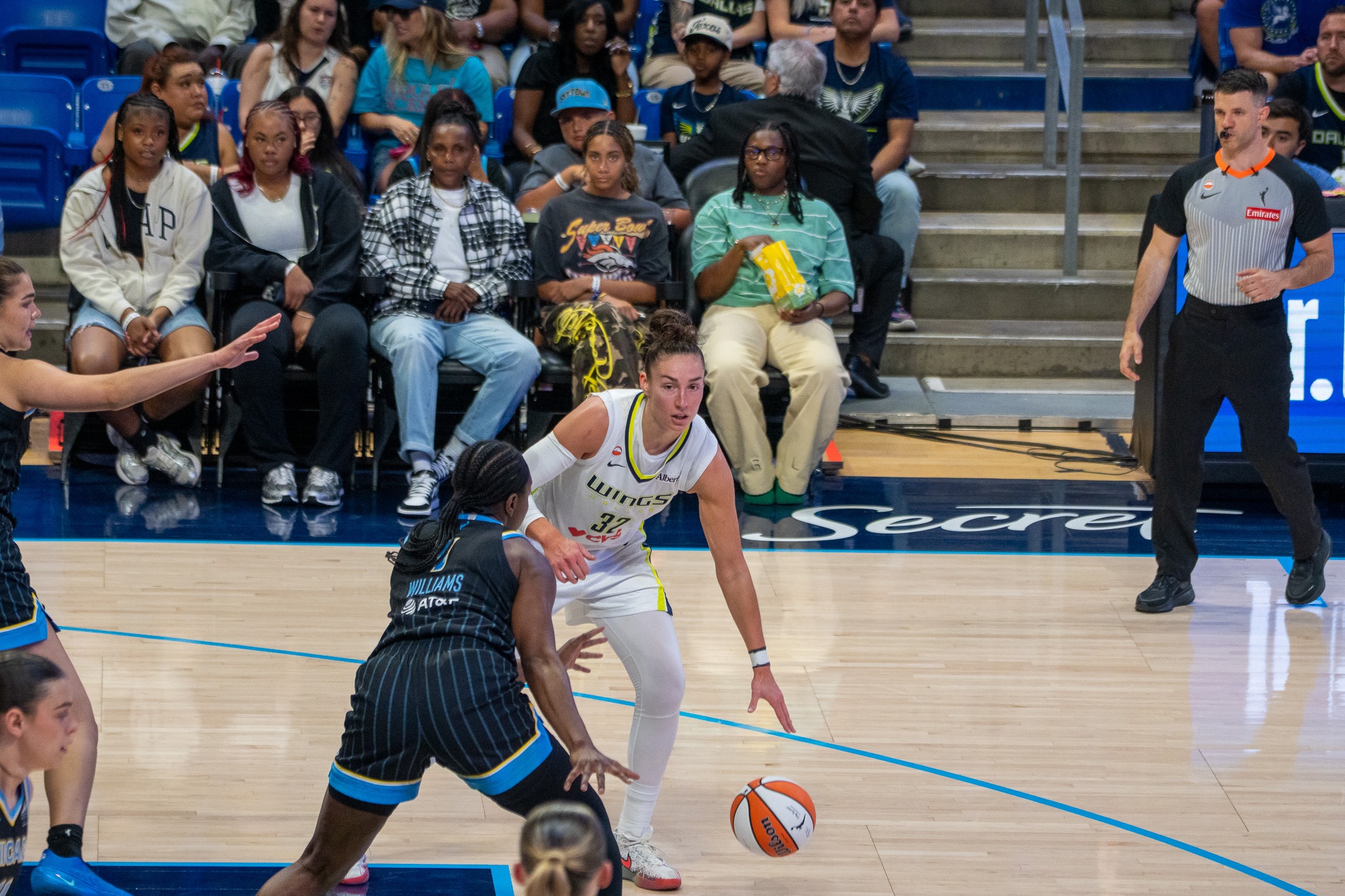
Jessica Shepard (32) of the Dallas Wings is taking flight with a career season-to-date. (Photo: Mason Garcia | The Podium Finish)
ARLINGTON, Texas — Long after the final buzzer sounds and the arena lights dim, the physical toll of a WNBA frontcourt battle remains etched in the box score. For Dallas Wings forward Jessica Shepard, Saturday night’s grueling 93-92 comeback victory over the Chicago Sky was just the latest chapter in a season defined by relentless interior labor and an unprecedented statistical evolution.
Faced with a 14-point deficit entering the fourth quarter against the formidable defensive frontline of Kamilla Cardoso and Azurá Stevens, Shepard served as the emotional and physical anchor for Dallas. She logged 21 points and eight rebounds over 34 minutes of action, taking direct hits in the paint to put the Wings in position for a dramatic, final-second victory.
Yet, the performance was less a surprise and more a confirmation of a broader reality: Shepard has quietly transformed herself into one of the most uniquely versatile, indispensable frontcourt players in the league. Her breakout campaign has single-handedly altered the competitive ceiling for the Dallas franchise, providing an elite interior engine that matches production with raw leadership.
The Evolution of an Elite Post Facilitator
To understand Shepard’s impact on the 2026 campaign is to look beyond traditional low-post scoring. Through 16 games, the 6-foot-4 forward is averaging 14.2 points, 11.3 rebounds, and 5.4 assists per contest. This rare statistical combination makes her a walking double-double and an imminent triple-double threat every single time she steps onto the hardwood.
The hard work is not unnoticed for Shepard as she ranked sixth in the WNBA All-Star Voting 2026 presented by Ally results as of June 17, 2026.
Likewise, the numbers represent a massive leap from her career benchmarks of 7.7 points, 7.0 rebounds, and 3.0 assists per game over her five years of professional experience. By pairing elite rebounding numbers with the passing vision and distribution instincts of a point guard, Shepard has provided head coach Jose Fernandez with a unique tactical hub. Her development has resolved spatial issues for the Dallas offense, turning the high post into a primary launching pad for the team’s half-court execution.
The consistency of her all-around game has altered how opponents must game-plan for Dallas, as she systematically punishes defenses that choose to overcommit to perimeter coverages. On May 20 against Chicago, Shepard orchestrated the offense from the high post, dishing out a season-high 12 assists alongside 18 points and 10 rebounds. Then, on May 28 against Las Vegas, she showcased her pure physical dominance on the glass, securing 20 rebounds to complement 22 points in 38 grueling minutes of action.
More recently, an efficient 15-point, 15-rebound, nine-assist performance against Las Vegas on June 15 yielded a season-best plus-minus rating of plus-24. When defenses collapse on guard Arike Ogunbowale or look to limit Paige Bueckers on the perimeter, Shepard’s ability to facilitate out of double-teams keeps the Dallas offense fluid. This playmaking layer has unlocked a highly dynamic transition game, allowing the Wings to push the pace off defensive rebounds without waiting for a traditional guard reset.
Navigating Physical Adversity Under the Rim
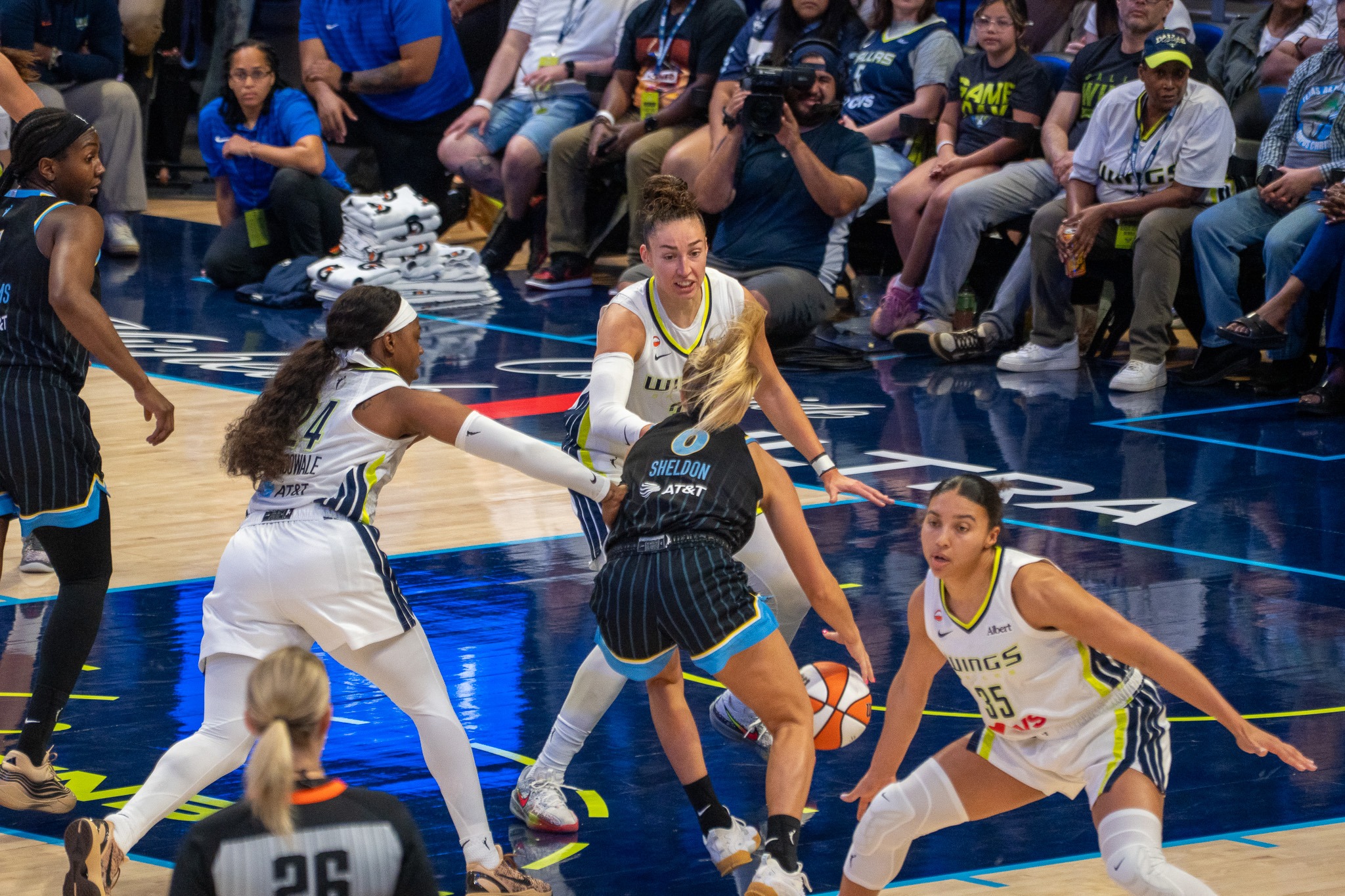
Jessica Shepard (32) of the Dallas Wings challenges Jacy Sheldon (0) of the Chicago Sky on the defensive end. (Photo: Mason Garcia | The Podium Finish)
Saturday’s matchup against Chicago demanded every bit of that veteran versatility. Cardoso established deep positioning early, using her size to alter shots and limit the Wings’ initial offensive sets. With perimeter shots failing to drop through the first three quarters, Shepard became the primary source of interior resistance, absorbing contact and generating secondary scoring opportunities when the offense stalled.
During the post-game media availability, Shepard deflected credit for the frontcourt turnaround to backup center Li Yueru, highlighting the collective effort required to neutralize Chicago’s length.
“Cardoso is a great player and when she gets the ball deep it is really hard to stop her,” Shepard said. “But I think in the second half, Li did a great job of making her catches hard, kind of wearing her down. That was a huge lift for the team.”
By drawing fouls and consistently converting high-contact attempts at the rim, Shepard finished the evening shooting 7 of 14 from the field and 7 of 8 from the free-throw line. Her persistence inside opened up the necessary perimeter daylight for Bueckers’ late-game scoring surge and set up the final, game-winning sequence at the charity stripe. Her willingness to battle through structural disadvantages against taller opponents has defined her role as the team’s physical compass.
From Role Player to Foundational Star
Shepard’s trajectory from a reserve rotational asset earlier in her career to a premier standard-bearer in the Western Conference highlights a meticulous development process. Drafted in the second round in 2019 out of Notre Dame, her initial professional seasons were marked by flashes of excellence mixed with structural limitations within the systems she operated under.
The 2026 campaign has served as a complete breakout, validating the investment the Wings organization made in expanding her offensive responsibilities. By giving Shepard the autonomy to initiate sets from the elbow, Fernandez has unlocked a secondary dimension to the roster. Opposing centers who are accustomed to staying anchored in the restricted area are forced to guard Shepard out to the perimeter, creating massive driving lanes for the Dallas backcourt.
Furthermore, her processing speed out of short-roll situations has become elite. When opponents trap the Dallas pick-and-roll, the ball invariably finds Shepard in the middle of the floor, where her decision-making yields high-percentage corner looks or precise drop-pass layups to cutting teammates. This evolution has alleviated immense pressure from the perimeter rotation, allowing the team to maintain structural offensive efficiency even during prolonged cold stretches from the outside.
Leadership and Accountability in the Locker Room
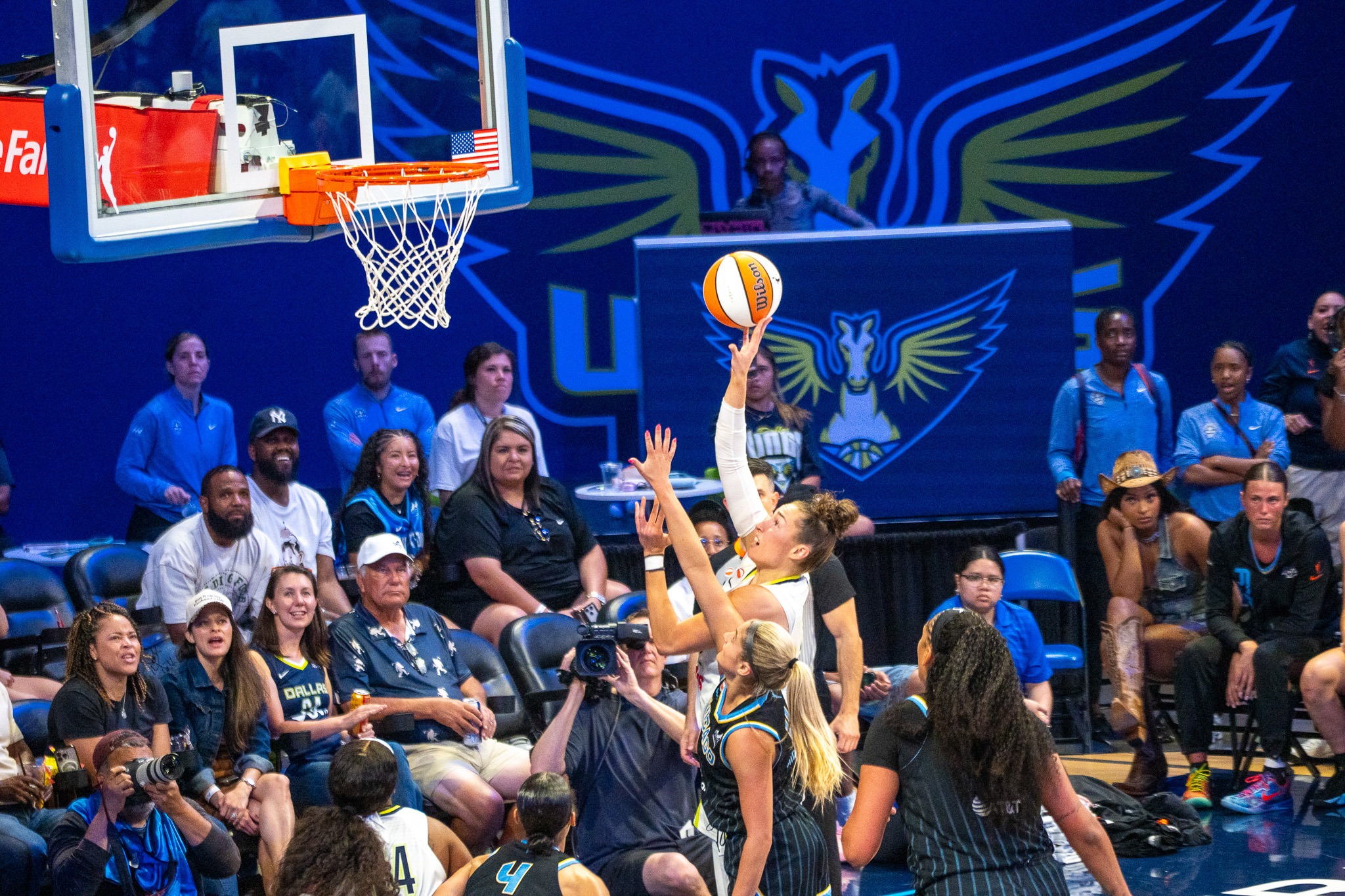
Jessica Shepard can be counted on for the tough, points in the paint for the Dallas Wings. (Photo: Mason Garcia | The Podium Finish)
Shepard’s statistical dominance is closely paired with a vocal, demanding leadership style that teammates have come to rely upon. Her steady approach during moments of high deficit has infused the roster with a distinct sense of calm, preventing early-game execution errors from snowballing into insurmountable leads.
Bueckers noted that the team’s ability to stay unified during a difficult three-quarter stretch is a direct reflection of the frontcourt’s resilience.
“We work so hard in this sport and some nights it is not your night shooting the ball, but until the buzzer sounds, things can always change,” Bueckers said. “That is kind of what we did as a team, we stuck with it. We were resilient.”
That collective resiliency allowed Dallas to secure its most explosive offensive quarter of the year, outscoring Chicago 36-21 in the final period. Following the victory, Fernandez praised the competitive growth of his group, emphasizing the defensive identity championed by his veteran forward.
“We have to clean up our slow starts, but the grit this group showed to stay together down 14 is a testament to their growth,” Fernandez said.
Yet, despite the celebratory environment of a one-point victory, Shepard demonstrated why she holds the respect of the locker room. Rather than focusing entirely on the celebration, she immediately turned her attention toward structural corrections, issuing a direct challenge to the starting unit regarding their game preparation.
“Today as starters we did not do a great job of coming out with the energy and the intensity that we needed on both sides of the ball, really,” Shepard said. “And so I think that depends a lot on the starters just being ready from the jump.”
A Foundational Anchor for a Championship Contender

Jessica Shepard (32) and her point-forward mentality has paid dividends for the Dallas Wings. (Photo: Dallas Wings)
As the Wings look ahead to a challenging western road swing, Shepard’s presence gives the organization an identity capable of competing with any frontline in the WNBA. Her transition from a reliable role player earlier in her career to a nightly double-double force has fundamentally altered the ceiling for this Dallas roster. Her ability to impact winning across multiple statistical categories ensures that even when her scoring output dips, her floor game remains exceptionally high.
The roster depth has benefited significantly from her emergence, as her facilitating allows secondary cutters and bench personnel to transition into functional roles without experiencing a drop-off in systemic execution. This structural stability is exactly what elite franchises require to navigate the grueling stretches of the regular season schedule.
If the opening months of the season are any indication, Shepard’s breakout year will be defined by more than just personal statistical milestones or individual accolades. By balancing elite playmaking with a relentless work ethic on the glass and an uncompromising standard of internal accountability, she has established herself as the foundational anchor of a legitimate championship contender in Dallas.
Editor’s Note
Mason Garcia, Multimedia Journalist, contributed to this article directly onsite from College Park Center in Arlington, Texas.