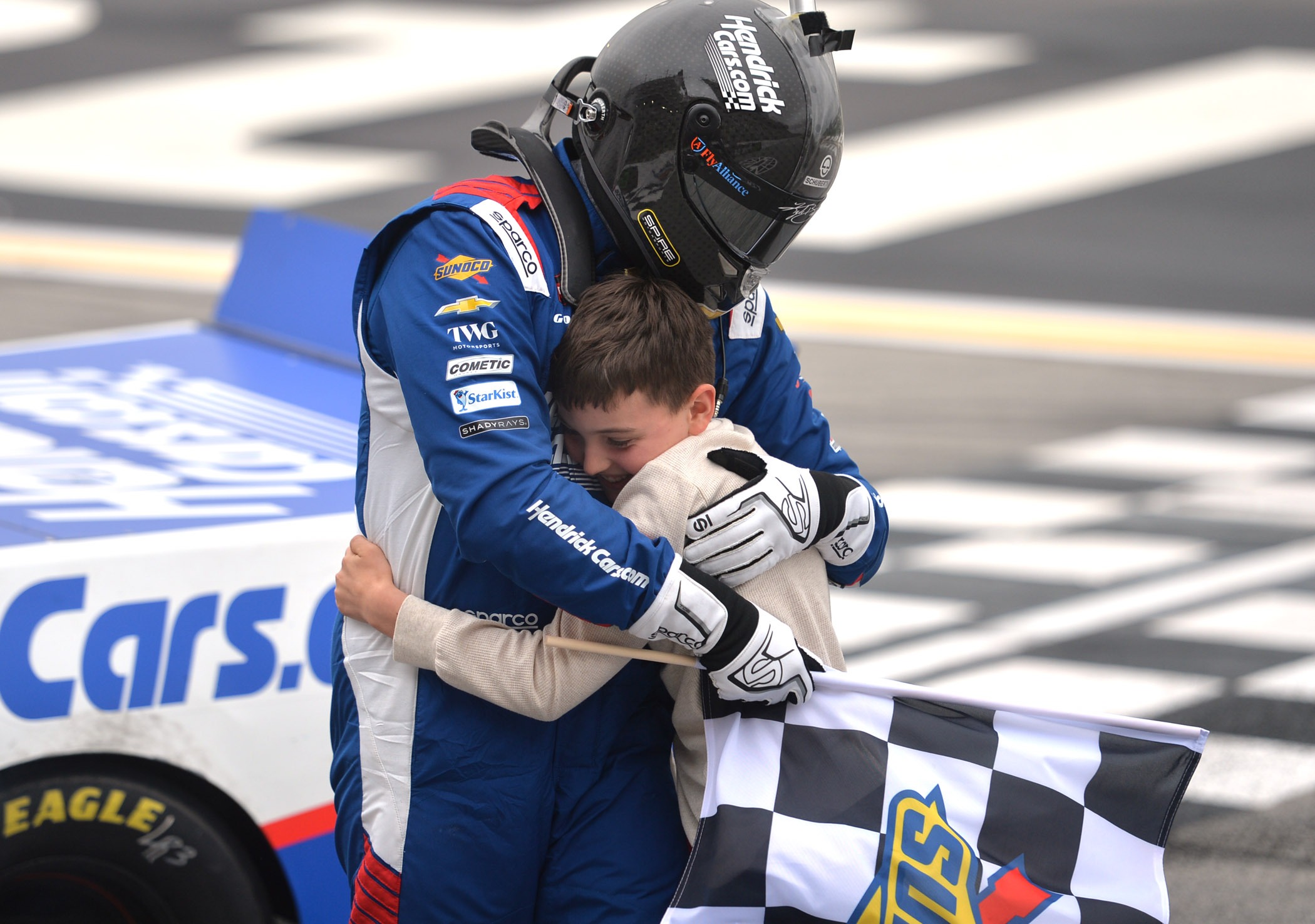
Kyle Busch shares an emotional embrace with his son, Brexton, on the frontstretch at EchoPark Speedway in Hampton, Georgia. (Photo: Phil Cavali | The Podium Finish)
GEORGETOWN, Texas — The garage area at a NASCAR race track is a sensory overload of air wrenches, the smell of burning high-octane fuel, and the constant hum of generators. Yet, when Kyle Busch walked through that space, a distinct aura surrounded him. It was an environment of pure, unfiltered intensity.
Following the sudden and tragic passing of the two-time NASCAR Cup Series champion at age 41 on Thursday, the motorsports world is left searching for answers. The staggering statistics will dominate the headlines, including his 63 Cup Series victories and a record-breaking 234 triumphs across NASCAR’s top three national divisions. But those numbers only tell part of the story.
To truly understand the driver nicknamed Rowdy, one had to observe him not just in the celebratory confetti of victory lane, but in the quiet, tense moments after a race had slipped through his fingers. For a competitor who openly detested finishing second, his true evolution as a generational talent was showcased in how he navigated the bitter taste of defeat.
The Cerebral Shift: Anatomy of a Champion
The journey to becoming a sport titan required a delicate balance of unyielding aggression and calculated patience. That balance was never more apparent than during his historic 2015 championship campaign.
After missing the first 11 races of that season with a fractured right leg and left foot suffered in an NASCAR O’Reilly Auto Parts Series crash at Daytona International Speedway, Busch faced an unprecedented uphill battle to gain a medical waiver and climb into the top 30 in points.
The turning point of that magical summer occurred on a very humid, sweltering Sunday at New Hampshire Motor Speedway in July 2015. Winning the 5-hour Energy 301 required outsmarting and outlasting his fiercest rivals, including Brad Keselowski.
In the media center following that victory, a youthful exchange captured the essence of Busch’s specialized driving approach. When asked about the technical chess match required to defeat the Team Penske organization at one of their strongest tracks, Busch offered a knowing smile.
“That’s a trick question because when I was at Hendrick, we had completely different packages back then,” Busch explained. “There were all kinds of different things through those years that I was there. And then when I came to JGR, it was the wing car, and then it went back to a spoiler car… So it’s hard to really compare years to years or teams to teams just because of how much changing goes on in our sport. But I feel like the thought process behind what I do here and how I run this racetrack hasn’t changed. It’s just a matter of trying to get the car to manipulate the track the way you want it to.”
That New Hampshire victory proved that Busch was no longer just a raw, volatile speed merchant. He had matured into a cerebral tactician, a transformation that ultimately propelled him to his first Bill France Cup under the most grueling circumstances imaginable.
Cutting Through the Garage Noise
Four years later, during a June 2019 press conference at Michigan International Speedway, that unfiltered authenticity was on full display. When pressed on how he insulated himself from constant outside criticism, Busch locked eyes and delivered a core truth about his identity.
“How do I stay true to myself? Just do, I don’t listen to y’all. Just do what I do,” Busch said with a characteristic smirk. “You know, everybody has their own opinion, just like everybody has their own you-know-what. So I don’t really worry about that, and I tell it like it is. I tell the truth, and I focus on what I need to focus on when that point comes.”
While major network outlets frequently weaponized statements like those to paint him as adversarial or short with the press, the reality inside the room was entirely different. He didn’t listen to the collective media pack because they were routinely chasing emotional drama and clickbait soundbites. If a journalist approached him with professional equity, the protective armor immediately vanished.

Kyle Busch wheels his No. 18 M&M’s Toyota Camry around Homestead-Miami Speedway during his dominant, championship-clinching drive in November 2019. (Photo: Josh Jones | The Podium Finish)
During a deep-dive interview conducted following the onset of the pandemic, Busch shared a reflection that has become incredibly haunting given the timing of his passing. When asked how he viewed his ultimate legacy and what he cherished most about his historic duels on the track, the two-time champion firmly pushed the conversation into the future.
“I will probably reflect more on that when I’m done in my career, which is much further down the line,” Busch noted. “That’s probably something I’ll look back on years from now more than I do now. I still have plenty of work to do.”
Regarding his legendary on-track battles with his brother, Kurt, he added a similar sentiment, stating it was something they would think about and talk about years from now when they weren’t racing anymore, noting it was an exchange that would happen down the road.
Because that hypothetical road was tragically cut short, the duty of contextualizing that massive legacy falls on the archive of work he left behind. The true measure of his veteran leadership was showcased when the racing gods withheld the checkered flag, a maturity that defined his later career campaigns.
The Man Behind the Visor
While mainstream outlets will spend weeks replaying the iconic highlights, the public narratives often missed the quiet, transformative impact Busch left on the lives of those away from the pit box. Through his personal experiences with infertility, Kyle and his wife, Samantha, established the Bundle of Joy Foundation, providing vital financial grants to couples undergoing reproductive treatments.
For members of the racing community like Nena Glass and her husband, Jarrett, that foundation was a life-altering turning point. Invited to Charlotte Motor Speedway on May 20, 2017, under the guise of being guests of another driver, the couple was completely blindsided when Kyle and Samantha walked in to surprise them with an IVF grant.
“Hola, cómo estás?” were the first words Busch said to them that afternoon, leaning fully into the moment with a wide smile, laughing and joking to ease the emotional gravity of the room. It was the beginning of a profound relationship that extended far beyond a standard charitable presentation.

Kyle and Samantha Busch share a moment with the Glass family during a foundation event. (Photo: Nena Glass and Glass Family)
Busch would later announce the gender reveal for the Glass family and celebrated the birth of their son, Rocco. Years later, after a crushing, heartbreaking near-miss in the Daytona 500, a defeated Busch walked down a hallway at Kyle Busch Motorsports. While casual observers might have expected the notoriously competitive driver to be closed off and unapproachable, he stopped completely just to express how much a good luck video from the foundation children had meant to him.
That sharp, mischievous humor remained an absolute constant. Backstage at a charity fashion show this past September, Busch stood with the family reminiscing about how their original grant came to be funded, tracking it directly back to his famous “Everything is great” media confrontation with Joey Logano in Las Vegas.
Amused by the connection, Busch grabbed young Rocco by the hand, marched straight over to Logano in the garage area, and pointed at the child.
“Hey Joey, there’s someone you need to meet,” Busch said with a grin. “This little boy is here because of our fight in Las Vegas.”
That was the genuine, unscripted individual the garage community knew, a man who utilized his platform to build families and left an indelible mark on those who looked beyond the standard sports headlines.
Finding Grace in the Quiet Moments of Defeat
A prime example of this evolution took place in October 2021 at the Charlotte Motor Speedway ROVAL. Competing in the final elimination race of the Round of 12 in the NASCAR Cup Series playoffs, Busch and his No. 18 Joe Gibbs Racing team fought a stubborn balance on the specialized road course layout.
Despite missing the optimal handling package to dominate the event, Busch maximized every single lap. He extracted a hard-fought fourth-place finish, securing enough points to advance his team into the Round of 8.
On pit road after the checkered flag, amidst the chaotic scene of media members and crew members packing up equipment, the typical post-loss anger was absent. Instead, Busch stood by his car and methodically dissected the afternoon.
“We got everything we could out of it today,” Busch said calmly. “I felt like if you were out front, you could kind of sail away and get gone. That’s kind of what we did in Stage 2. But it seemed like everybody was pretty equal through traffic. Once everything kind of got single-filed out, there wasn’t really anybody killing the field. I guess that’s pretty equal racing. But overall, it was a good day for us on our M&M’s Camry.”
It was the demeanor of a master craftsman who respected the discipline of execution over the emotion of the moment.
That quiet resilience was tested even further during his final tenure with Richard Childress Racing. At the Circuit of the Americas in March 2025, Busch found himself squarely in contention to snap a prolonged winless streak that had tested the patience of Rowdy Nation.
Driving the No. 8 Rebel Bourbon Chevrolet Camaro, Busch drove a flawless race, putting all the tactical pieces together to challenge Christopher Bell for the victory. In the closing laps, a lack of fresher tires forced Busch into a strictly defensive driving line, ultimately relegating him to a painful fifth-place finish.
The old Kyle Busch might have slammed a window net or walked away from the microphones. Instead, the veteran driver met reporters on pit road with a clear-eyed, protective attitude toward his crew.
“It was definitely good,” Busch explained. “Anytime you run good, that’s obviously a positive, so I am real happy with the guys and everybody on the Rebel Bourbon Chevrolet. We put all the right pieces together. We just maybe didn’t have the two lap fresher tires that we needed there at the end to be able to compete. I felt we were pretty evenly matched, and maybe the tires were just that much of a difference. When I had to start running that defensive line, that just killed us, so it just is what it is.”
He didn’t offer excuses. He accepted the reality of the sport, acknowledged the then technical alliance gains made between the Richard Childress Racing and Kaulig Racing campuses, and focused on the broader, positive direction of his organization.
“Obviously that’s what it’s all about,” Busch noted regarding the collaborative effort. “Four cars is going to be stronger than two, so I appreciate everybody at Kaulig and everybody there doing what they do to help us, and us helping them. It is a mutual thing, and we are able to be stronger together.”
It was a masterclass in professional grace from a man who still fiercely wanted to win.

Rejuvenated by a fresh chapter with Richard Childress Racing, Kyle Busch hoists the trophy at World Wide Technology Raceway alongside team owner Richard Childress in June 2023. (Photo: Travis Haston | The Podium Finish)
A Blueprint Left Behind
In my 20 years total and 11 years I spent covering NASCAR onsite for The Podium Finish, Kyle Busch was a driver who consistently demanded your absolute best as a journalist. He possessed a notorious lack of patience for repetitive or superficial questions. If you approached him with a query grounded in the technical realities of tire fall-off, aerodynamics, or team dynamics, the armor instantly dropped. He remembered the reporters who did their homework, granting them a level of professional respect that was earned, never given.
The garage opened on Friday morning. On Saturday, the engines will fire for practice ahead of the Coca-Cola 600, but the landscape of the sport has fundamentally changed. The missing presence of the No. 8 Chevrolet will be a visual void that will take a long time to process.
NASCAR lost a titan, an irreplaceable piece of its modern identity, and a competitor whose hunger defined an entire generation of racing. Rowdy is gone, but the blueprint he left behind on how to win with conviction and how to handle defeat with dignity will endure forever.