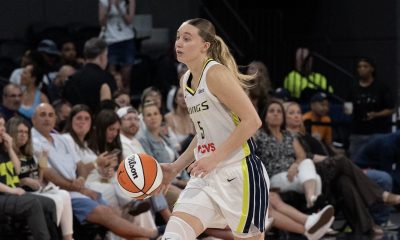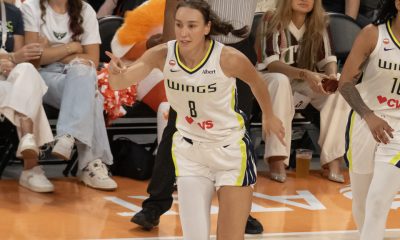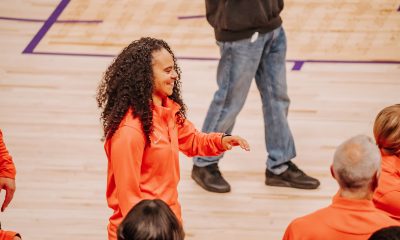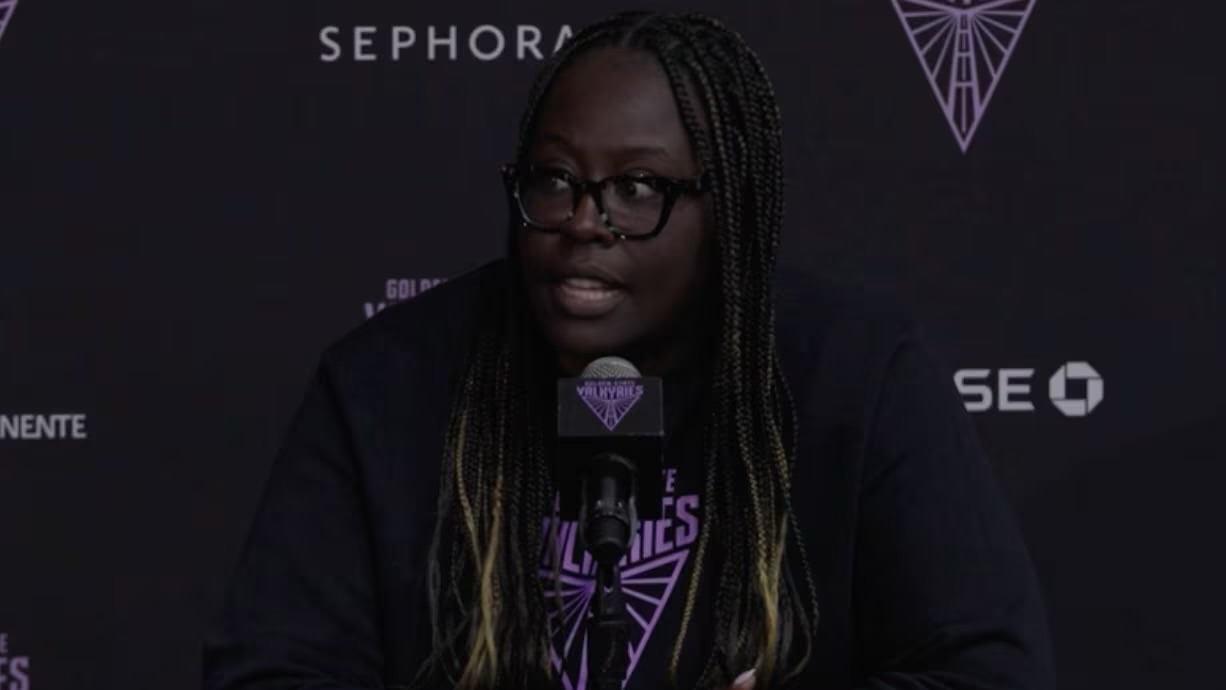
Golden State Valkyries General Manager Ohemaa Nyanin at 2026 Media Day. (Photo: Golden State Valkyries)
OAKLAND, Calif. –– On a cloudy Tuesday afternoon in Downtown Oakland, CA, Golden State Valkyries General Manager Ohemaa Nyanin held her second media availability since the 2026 WNBA Draft. In the weeks since the Valkyries traded the draft rights to LSU guard Flau’jae Johnson (#8 pick) to the Seattle Storm in exchange for the draft rights to TCU forward Marta Suárez and a 2028 Second Round Pick, the Valkyries front office, specifically Nyanin, has come under an avalanche of scrutiny and criticism from fans and media alike.
In a vacuum, the decision to trade down from pick #8 to pick #16 while only netting a single 2028 Second Round Pick remains questionable. In past drafts, we have seen teams that trade out of the First Round altogether receive a future First Round Pick in order to roll over their draft and trade maneuverability. Given that Second Round picks have a historically lower success rate of making a WNBA roster than First Round picks, it seemed counterintuitive for the Valkyries to agree to enter a situation in which they would eventually be drafting two players who are significantly less likely to make their 12-player roster than any single player they could have selected at pick #8.
When you factor in that the #8 pick eventually became Flau’jae Johnson, a decorated NCAA prospect with perceived high upside, the trade fails to produce positive value or clarification with regards to the long-term vision for this team.
To her credit, Nyanin was both assertive and poised when giving her opening statement to the assembled media. After acknowledging the difficulty of an expedited offseason, Nyanin stated that the team’s priority was to bring back as many players from last year’s squad while maintaining enough cap flexibility for a few potential upgrades.
“This offseason has been one that has been condensed in nature and also very exciting,” said Nyanin.
“What we were able to do during the expansion draft was pretty sad. We lost two elite athletes in Maria Conde (Toronto Tempo) and Carla Leite (Portland Fire), and then in quick succession, we had free agency. And at that time, I only had one athlete on our cap. And the idea was to make sure that we were able to sign as many returners as possible and then hopefully sign some new athletes. And so, the ability to sign Gabby Williams and Kiah Stokes with championship caliber was really exciting. And then we had the draft. And the decision-making around the draft had a lot to do with cap flexibility.”
Nyanin’s description of Golden State’s offseason approach aligns with what Head Coach Natalie Nakase has been preaching throughout training camp: maintaining continuity and connectivity gives the Valkyries their best shot at winning at an elite level.
To be fair, the projected starters returning from last year’s squad (Veronica Burton, Kayla Thornton, Janelle Salaün, and Iliana Rupert) did not play many games together due to injury and extended absences for national team commitments during 2025 FIBA Eurobasket. Rupert, in particular, was a gamechanger for the Valkyries’ offense. In lineups that featured Burton and Rupert, Golden State registered a 117 offensive rating (ORTG). For context, the Minnesota Lynx led the league in offense with a 112.3 ORTG.
It is not unreasonable if Nyanin and Nakase believe a healthy Thorton, a full, uninterrupted season with Rupert, and the addition of former Seattle Storm guard/forward Gabby Williams could catapult Golden State toward the top of the league in offensive production.
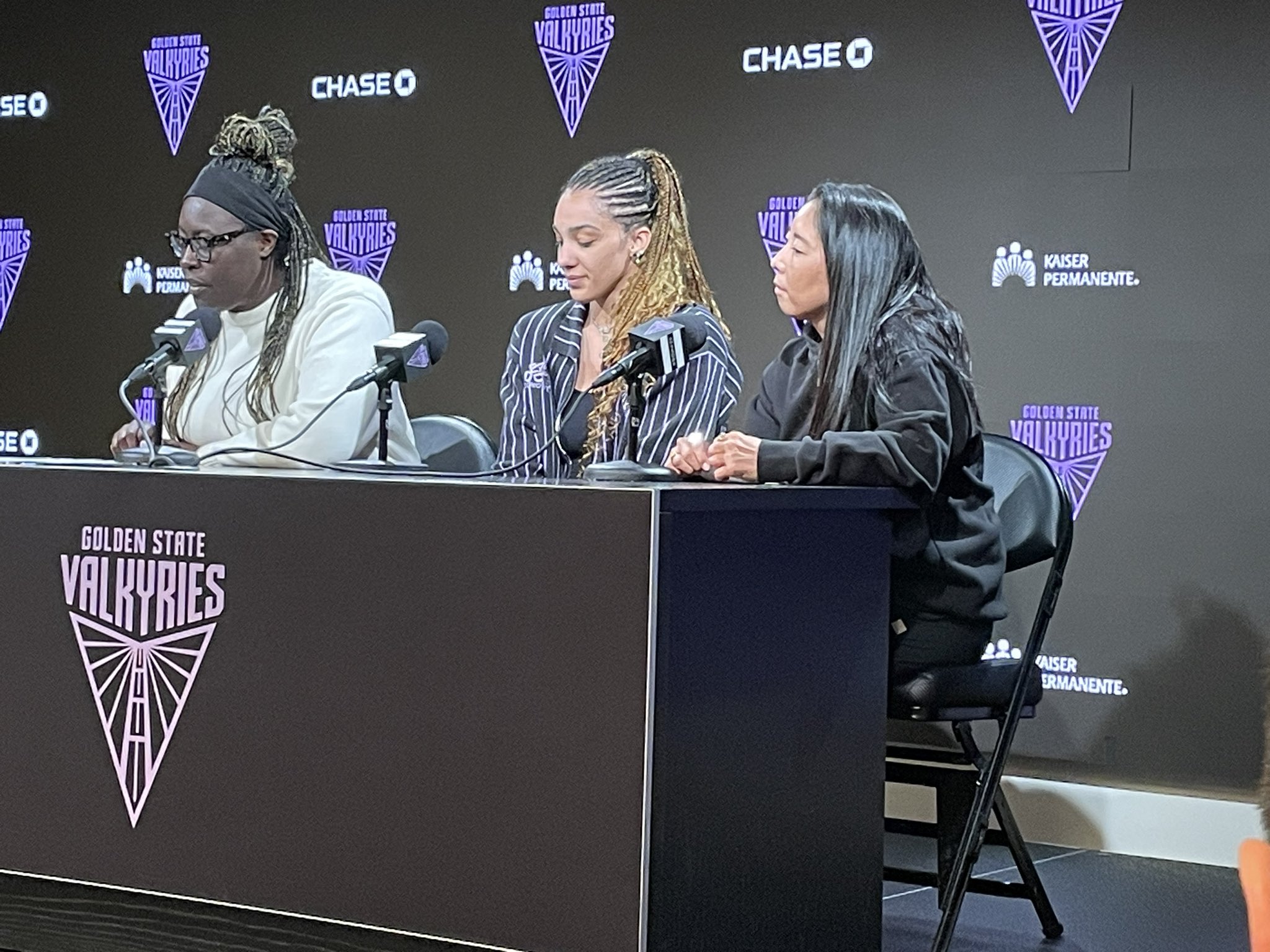
Valkyries General Manager Ohemaa Nyanin, G/F Gabby Williams, and Head Coach Natalie Nakase speaking to the assembled media during Williams’ introductory press conference prior to Golden State’s lone preseason game vs the Seattle Storm. (Photo: Conrado Pascual | The Podium Finish)
While there is legitimate merit to following this strategy, it still does not explain why the Valkyries’ draft day trade itself seemed rushed and counterproductive to what they were trying to accomplish.
According to Nyanin, “the trade was for the rights of the number eight pick for the number 16th pick and a future second. And no athlete was considered at that moment in terms of us trading an athlete at number eight. It wasn’t decided before, but there was the option to execute the trade should both teams have wanted to execute the trade at the time.”
Regardless of what Golden State’s draft board looked like, or which prospects were still available at pick #8, it is becoming more and more clear that the Valkyries had no desire to make a selection in the First Round.
It is notable that there is approximately a $40K cap saving between signing the 8th overall pick and the 16th overall pick, so trading down to the top of the Second Round does support Nyanin’s stated goal of preserving maximum cap flexibility. But if the Valkyries were reluctant to add a First Round-grade talent to the main roster, why would they be more willing to add a Second-Round talent (or two when you factor in the other Second Round pick that eventually became Duke guard Ashlon Jackson)?
Make no mistake, healthy competition in training camp is a good thing. But if Golden State’s brain trust was determined to prioritize supplementing the returning players with established veteran free agents, then it is almost as if the Valkyries created a situation in which Marta Suárez and Ashlon Jackson never had the opportunity to forge a clear path at making the main roster.
Sure enough, Marta Suárez and Ashlon Jackson were among the six roster cuts that coincided with the return of Janelle Salaün, Iliana Rupert, Cecilia Zandalsini and Kaila Charles. 48 hours after being waived, it was announced that Suárez and Jackson would not be returning to Golden State despite both players having cleared waivers. With Suárez agreeing to a developmental player contract with the Phoenix Mercy and Jackson electing to continue her WNBA career with the Connecticut Sun, the Valkyries were left with the draft rights to Japanese guard Kokoro Tanaka, their Third-Round selection, as the last remnant of their confusing 2026 draft class.
Draft picks are not just the tickets used to gain access to young up-and-coming talent; they are also a form of currency in WNBA transactions. With a bevy of draft picks, a team gains more optionality. In turn, additional optionality allows a team to have greater control and influence on the decision-making made around the league.
As it currently stands, the Valkyries essentially gave away the #8 pick without receiving anything of tangible significance in return. The league is far too competitive for a recent expansion team to be making charitable donations to their rivals.
If the Valkyries were comfortable essentially punting on the 2026 Draft, why not trade out of the draft altogether? And even if there was not enough interest amongst rival teams to acquire their pair of Second Round picks, why did the Valkyries not entertain the idea of using all of their draft picks on international players who would be comfortable remaining draft-and-stash candidates for the foreseeable future?
For a team that has quickly garnered the reputation of being the United Nations of the WNBA and prides itself for having one of the most meticulous international scouting staffs, would it have been that shocking if Golden State had used their entire 2026 draft class to form the foundation for an international “farm system”?
Even if they would have been perceived as “reaches”, drafting two of Saffron Shiels, Ines Pitarch-Granel, Charlisse Dunn, Kejia Ran, Yunha Song or Eslem Guler in addition to Kokoro Tanaka would have at least ensured the Valkyries’ draft picks became reserved draft rights. These in turn would have remained cost-controlled assets. Not only could those reserved draft rights be used to supplement potential trades, but they could have also been used as a buffer in the upcoming Expansion Drafts.
When asked if she would have approached the draft differently had she known how free agency would have played out, Nyanin responded by saying:
“I’m an individual that is consistently and constantly evaluating myself and my decision-making and what could have happened. And I can’t do my job if I continue to create alternate universes as to, and allowing other variables that could or couldn’t have happened to try to continue to stay really locked in into the goal of creating a championship-caliber team. So very respectfully, like, I want to make sure that I answer it in a way that is authentic to the process, which is really understanding all of the different options that we had at that moment, making the decision, but also trying to give our team more specifically the flexibility to be able to make decisions differently.”
It is more than fair if Nyanin believed that cap flexibility and aggressively pursuing free agents took priority over the draft. But free agency does not replace or negate the draft. These are two separate roster-building opportunities that a front office should navigate in parallel to (and possibly in conjunction with) each other. Ultimately, the decision to prioritize cap space will be judged based on what players were acquired with the open cap space, not what players the team hoped to attract. And as the franchise’s lead decision maker, it is on Nyanin to not only understand the options available to her team but to also create more avenues to improve her club.
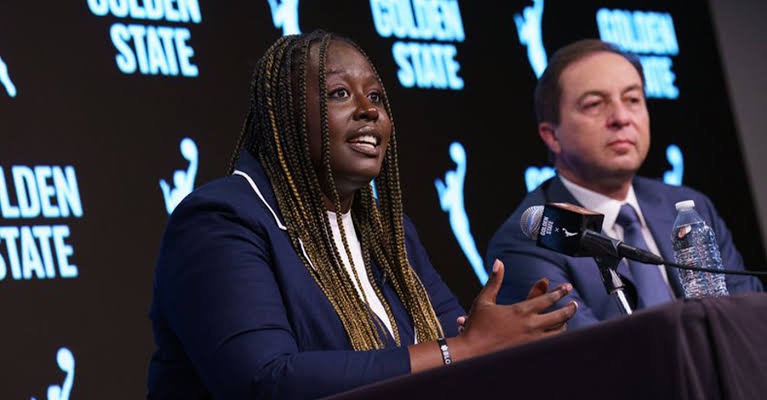
Golden State Valkyries General Manager Ohemaa Nyanin and Principal Owner Joe Lacob addressing the media prior to the 2025 WNBA Season. (Photo | Golden State Valkyries)
At the end of the day, fans ultimately care about winning. If the Valkyries win and win big, all of this trade discourse will be a forgotten footnote in this franchise’s history. However, it is the responsibility of the front office to not only maximize all of the roster-building tools and resources available to them, but to also exhaust any and every option to ensure the team has a sustainable and reproducible formula for success. Fans care about results; front offices should care about the process and the results.
With a new Collective Bargaining Agreement (CBA), league expansion, and the constant influx of international talent, it is not an easy task building a championship contending team in the modern WNBA. Having said that, the best front offices are the ones that can simultaneously master the intricacies of CBA, manage the salary cap, execute solid drafts, and address the ebbs and flows of a long season.
A good WNBA general manager can build a competitive team in any given season, but a great general manager can build a brand that defines an era and potentially lay the blueprint for the league’s future. After the first year of the Golden State Valkyries’ existence, Ohemaa Nyanin has proven she possesses the qualities of a good WNBA general manager.
It remains to be seen if Nyanin has what it takes to be a great general manager.