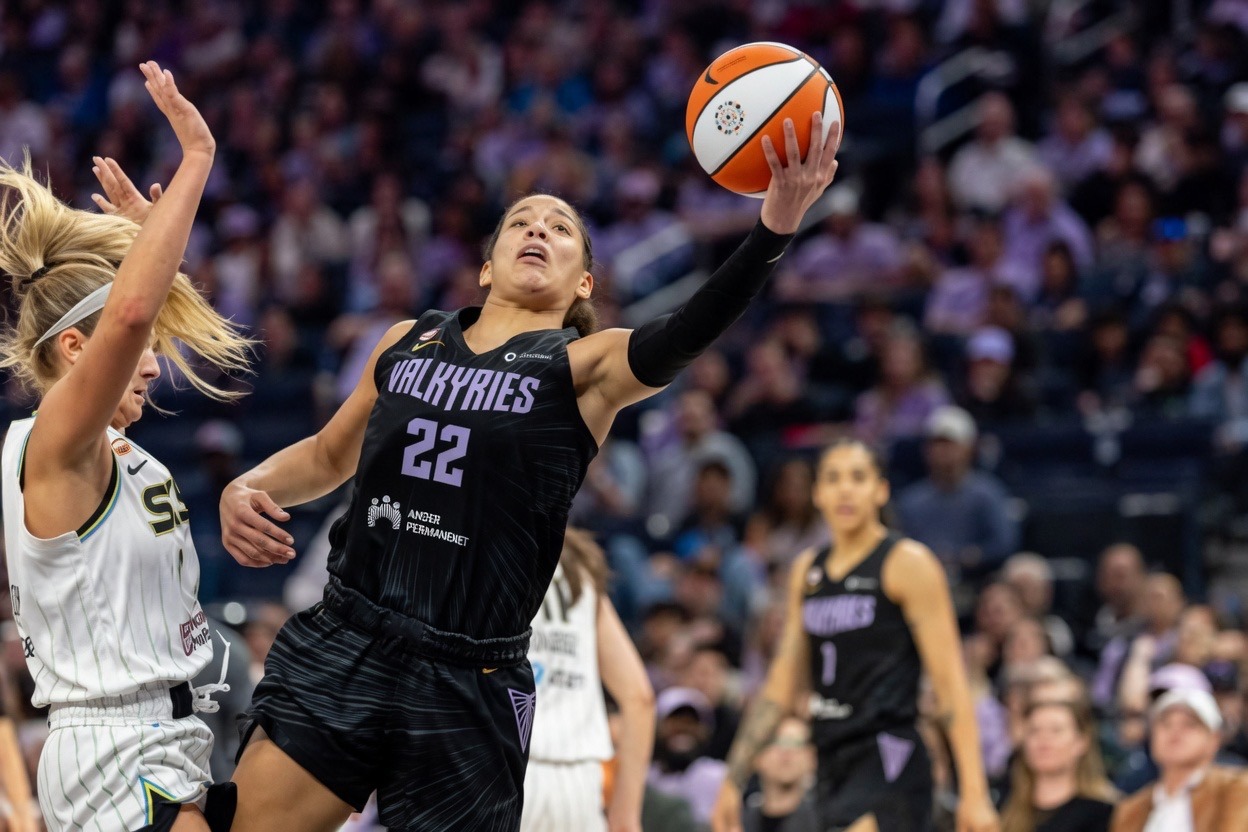
Golden State Valkyries guard Veronica Burton (22) puts up an awkward shot during the second quarter against the Chicago Sky at Chase Center on Wednesday, May 13, 2026. (Photo: Bob Kupbens | Imagn Images)
SAN FRANCISCO — Coming into Wednesday’s home game versus the Chicago Sky, the vibes were high in Ballhalla. The Golden State Valkyries kicked off the 2026 season with a 2-0 start that saw the team score 93.5 points per game while registering an average margin of victory of 13.5 points.
After their wins against the Seattle Storm and the Phoenix Mercury, the Valkyries were leading the league in offensive rating (124.3) while once again attempting the most three-pointers in the league (35.0 3PA/game) and also making the most three-pointers (14.0 3PM/game).
Whether it was due to circumstance (the absence of Iliana Rupert due to pregnancy) or the addition of new personnel (Gabby Williams), the 2026 Golden State Valkyries’ small-ball 5-out offense looked like an even more efficient and explosive version of their 2025 counterparts.
Although Valkyries head coach Natalie Nakase acknowledged the well-deserved excitement and enthusiasm from Golden State’s 2-0 start to the season, she did stress the importance of staying singularly-focused on the task ahead.
“At the end of the day, we just have to be prepared” said Nakase. “So it’s just exciting (but) at the same time, this game (versus Chicago) doesn’t have any more onus on compared to Phoenix or Seattle. We take every game as a win-or-die mentality and we just concentrate on that.”
The new-look Chicago Sky presented the Valkyries with a physical challenge from the onset of the game. With wing Rickea Jackson (6’2″) joining center Kamilla Cardoso (6’7″) in the frontcourt, the Valkyries found themselves at a size and length disadvantage in the painted area. Given this unique matchup, Nakase did not hesitate when explaining her key to the game.
“Speed,” Nakase said in a terse yet declarative manner. “Use our strengths. Use our speed.”
The first quarter played just as Nakase had described. Veronica Burton, Kaila Charles, and Williams were switching early and effortlessly at the point of attack, thus forcing Skylar Diggins to drive to her weak hand and settle for contested midrange shots. Likewise, Kayla Thornton and Kiah Stokes did their work early on defense and consistently beat Cardoso and Jackson down the court.
With Cardoso unable to establish deep position, the Sky attempted to allow Cardoso to post-up Stokes from 15 feet out. But with Charles and Thornton lurking to provide help-side defense, Cardoso was forced into errant shots or last-second kickouts to the wing.
To her credit, Stokes put together her best all-around half as a member of the Golden State Valkyries. Amidst all the criticism of her uneven play in the team’s first two games, Stokes came out playing with greater force and intentionality. By halftime, Stokes had completely outplayed Cardoso on both ends as she registered six points, nine rebounds, one assist, and four blocks while holding her Chicago counterpart to a forgetful zero points (0/5 FG) and two rebounds.
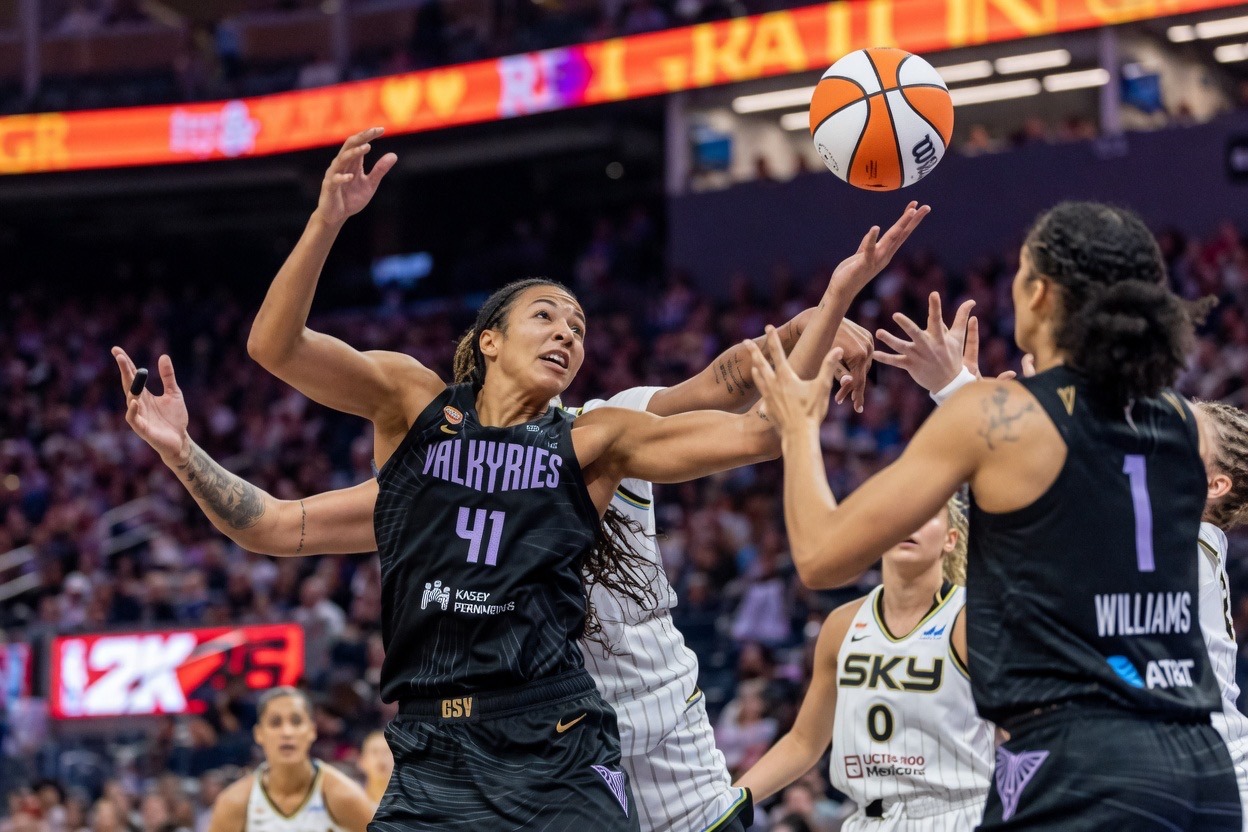
Golden State Valkyries center Kiah Stokes (41) fights for a rebound during the second quarter against the Chicago Sky at Chase Center. (Photo: Bob Kupbens | Imagn Images)
Defense is and always will be the Valkyries calling card, and sure enough, Golden State executed their game plan and held the Chicago Sky to 25.0% shooting from the field in the first quarter which included 0/5 from 3P.
As stifling as Golden State’s defense was in the first quarter, their offense left a lot to be desired. Even though Cardoso initially struggled to defend high ball screens, the Sky’s on-ball defenders were able to stay skinny when navigating screens and did just enough to jam Burton on the hip. In turn, the Sky’s perimeter defenders were able to stay home on Golden State’s shooters and the offensive stagnation that Valkyries fans had witnessed at the start of each of their first two games resurfaced in the second quarter. Despite taking a four-point lead into halftime, the Valkyries were held to 27.9% from the field while shooting 16.7% from 3P (2/12).
Unfortunately for the Valkyries, the Chicago Sky made subtle yet definitive adjustments of their own that ultimately swung the momentum of the game in their favor. From the onset of the second quarter, the Sky elected to hold Cardoso back in a high drop. Given that Stokes is not a threat to score from the perimeter, the Sky defenders continuously helped off of Stokes and worked to funnel Burton toward the middle of the court where Cardoso was camped out in the lane.
But the adjustment that Chicago made that the Valkyries ultimately had no answer for was the Sky’s tactical decision to move Cardoso back into a low drop while having each perimeter defender switch late in possessions. Other than Cardoso, every Sky defender applied maximum pressure to their respective defensive assignments (point-of-attack and off-ball).
By denying early ball movement and then switching late in the shot clock, the Sky essentially dared Golden State to create off the dribble and in mounting traffic. Sure enough, the Valkyries finished the game shooting 29.3% from the field for a lackluster 63 total points.
The Sky’s low drop + late switch strategy revealed (or confirmed) three things about the Valkyries’ offense: 1) even with the addition of Williams, Golden State does not have enough scoring threats off the dribble, 2) their best off-the-dribble scorers struggle to create separation without one or more established ball screens (not ghost screens or brush screens) and 3) the other Valkyries who are not ball-handlers struggle to create separation when moving and/or cutting off the ball.
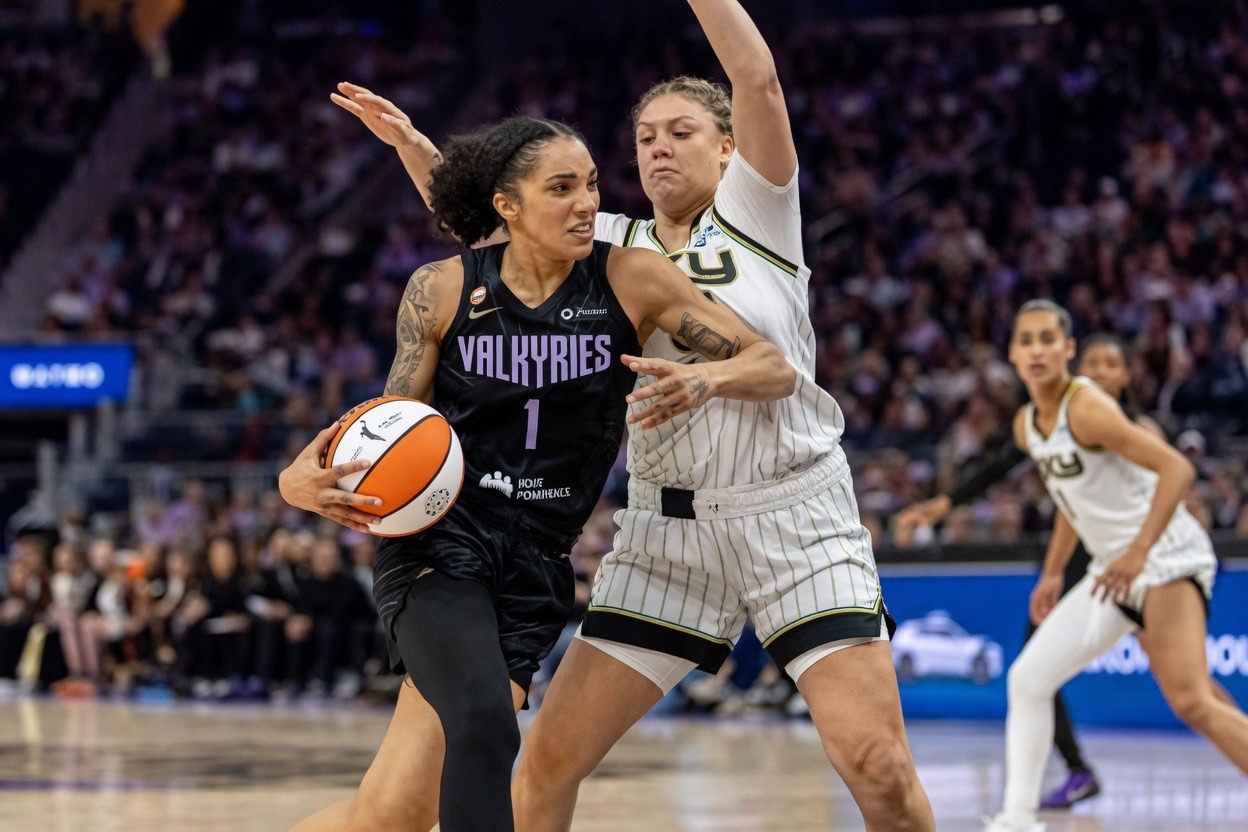
Golden State Valkyries forward Gabby Williams (1) drives against Rachel Banham during the second quarter against the Chicago Sky at Chase Center. (Photo: Bob Kupbens | Imagn Images)
Even during the team’s 2-0 start, the Valkyries were still dead-last in pace (74.8). In addition, the Valkyries were attempting the fewest corner three-pointers. The fact that they were first in offensive rating while being last in pace and corner 3-point attempts is indicative of the Valkyries’ systemic offensive problems: the Valkyries lack ball-handlers who can consistently attack and crack the paint. Because of the lack of ball-handlers, Golden State has to slow the pace down in order to get the ball back to Burton.
Because the team struggles to manufacture paint touches, they cannot spray to the corners with any regularity on drive-and-kick situations. What ends up happening is what Valkyries fans witnessed in the entire second half versus Chicago: the lack of dribble penetration forces the team to kick the ball back out to the wing, and the team ultimately lives and dies by the (above-the-break) 3P.
Valkyries fans often get frustrated by what appears to be a team-wide proclivity to spam 3-point shots, but the reality of the situation is that Golden State struggles to pressure the rim when their players are forced to operate outside of structured sets. The lack of shot-creating ability leads to a very predictable and streamlined shot profile.
This shortcoming becomes even further exacerbated when the team plays at a slow pace as a that inevitably yields fewer possessions. Ideally, a team with these offensive limitations should be looking to win the possession battle in order to compensate for the lack of shot-making versatility.
To be fair, the Valkyries do in fact produce a lot of quality point-blank looks despite involving non-shooters directly in the action. One of Nakase’s best plays of the game was having Kiah Stokes set a high ball screen, and instead of rolling directly to the rim, Stokes stopped at the midpost and audibled into a series of dribble handoffs (DHO).
Stokes ran this play six times and it resulted in three cutting layups (two for Williams and one for Burton) as well as three drawn personal fouls. Diggins, Cardoso and Jackson each got caught in no-man’s land on Stoke’s dribble handoffs and ended up fouling as they tried to recover on the cutting recipient of the DHO.
Stokes’ ability to draw three fouls when executing the same PNR + DHO play shows that the Valkyries can scheme up ways to force defenses to scramble while also drawing substantial contact. Through the first three games of the season, Golden State has drawn the sixth-most personal fouls per game (20.7). The Valkyries have gotten into the bonus before their opponents, but they have failed to capitalize on this advantage as shown by their mediocre free throw production; 18.7 FTA/game on a 25.9% free throw rate (FTr) has the Valkyries ranked 13th in the league in both free throw categories.
In an alternate universe, perhaps the Portland Fire went in a different direction during the 2026 WNBA Expansion Draft and the Valkyries would still have a certain 5’9″ French guard with a career 47.0% FTr on their roster. Even in the Valkyries’ two victories, it is easy to see how Carla Leite would have fit into this year’s squad and also why her unique skill set is missed.
For a team that draws a lot of non-shooting fouls, Leite is the exact type of driving/slashing guard who can pierce the heart of an opponent’s defense and get herself to the free throw line. More often than not, when a team wins the battle at the free throw line, they control the momentum of the game seeing as how they experience less offensive lulls.
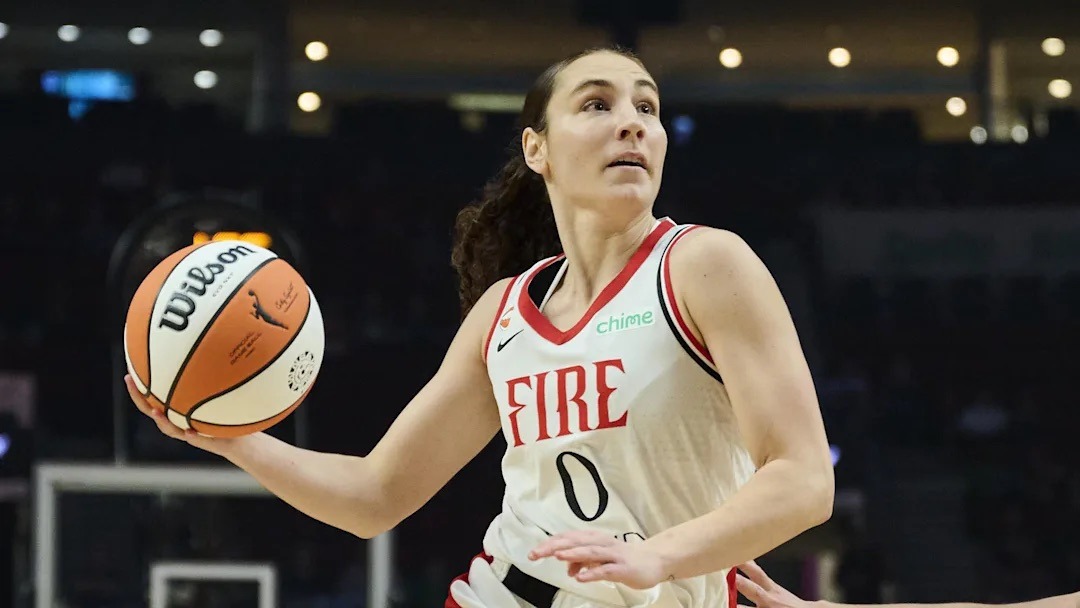
May 12, 2026; Portland, Oregon, USA; Portland Fire guard Carla Leite (0) drives to the basket during the first half against New York Liberty guard Pauline Astier (18) with help from center Luisa Geiselsoder (15) at Moda Center. (Photo: Troy Wayrynen | Imagn Images)
But in this universe, the eventual addition of Justė Jocytė, Golden State’s 2025 First Round Pick, will add a significant boost to the Valkyries’ halfcourt execution. Given Jocytė’s proficiency scoring and facilitating as a PNR ball-handler, it’s not unreasonable to think that the Valkyries offense could begin to flow more smoothly once her addition to the team allows her veteran teammates to get back to focusing on setting screens, cutting off the ball, and flaring or spotting up for catch-and-shoot opportunities. Although Jocytė is hardly a carbon copy of Leite, she does have the ability to attack the gaps with a series of stepback and side-step moves. Her offensive repertoire is enough to keep defenses honest and off-balance.
After the game, Nakase repeatedly took responsibility for the 69-63 loss and stated that the cumulative effect of multiple long and hard practices resulted in the team having “heavy legs.” What’s more fascinating is that while Nakase agreed that her team looked more reactive (as opposed to proactive) on defense, Nakase admitted that she could have been more proactive with her substitutions and lineup choices.
Hindsight is always 20/20 but given the team’s heavy legs combined with the energy Thornton and Stokes had to exert to keep Cardoso and Jackson out of the paint early in the game, it seems like there could have been an opportunity for Laeticia Amihere to get more than 10:42 of playing time.
In addition, the offense isn’t versatile enough to warrant limiting Janelle Salaün to 16:39 of playing time in which she only had 5 total field goal attempts. In fact, there is a case to be made that outside of Veronica Burton and Gabby Williams, Janelle Salaün is the least matchup-dependent player on the team. As a rookie, Salaün led the team in made contested 3-pointers (3-pointers in which a defender was within 5 ft of Salaün). Salaün shot a robust 36.4% on contested 3s on 107 3PA. Even if Salaün isn’t demanding more touches, the team should be looking for her on every possession.
When all is said and done, the loss to Chicago doesn’t negate nor does it downplay the significance of the team’s wins versus Seattle and Phoenix. What it does do is serve as a reminder that this is still a learning period for Nakase, her coaching staff, and the entire team. Conditioning, health maintenance (mental and physical), shot profiles, lineup combinations, timing and on-court chemistry are all things that are being explored and developed in parallel to each other.
“We are a defensive team,” Nakase said succinctly.” I have to make sure that they understand who we are, and I have to maintain and punch more into our discipline and the layers of our defense, that has to be there. We can’t just rely on getting Ballhalla all excited in terms of our shooting.”
It would be easy to discuss the 2026 Golden State Valkyries in terms of their perceived limits but based on the collective buy-in from Nakase and her players, it’s becoming clear that the sky is not the limit; it’s just the beginning.