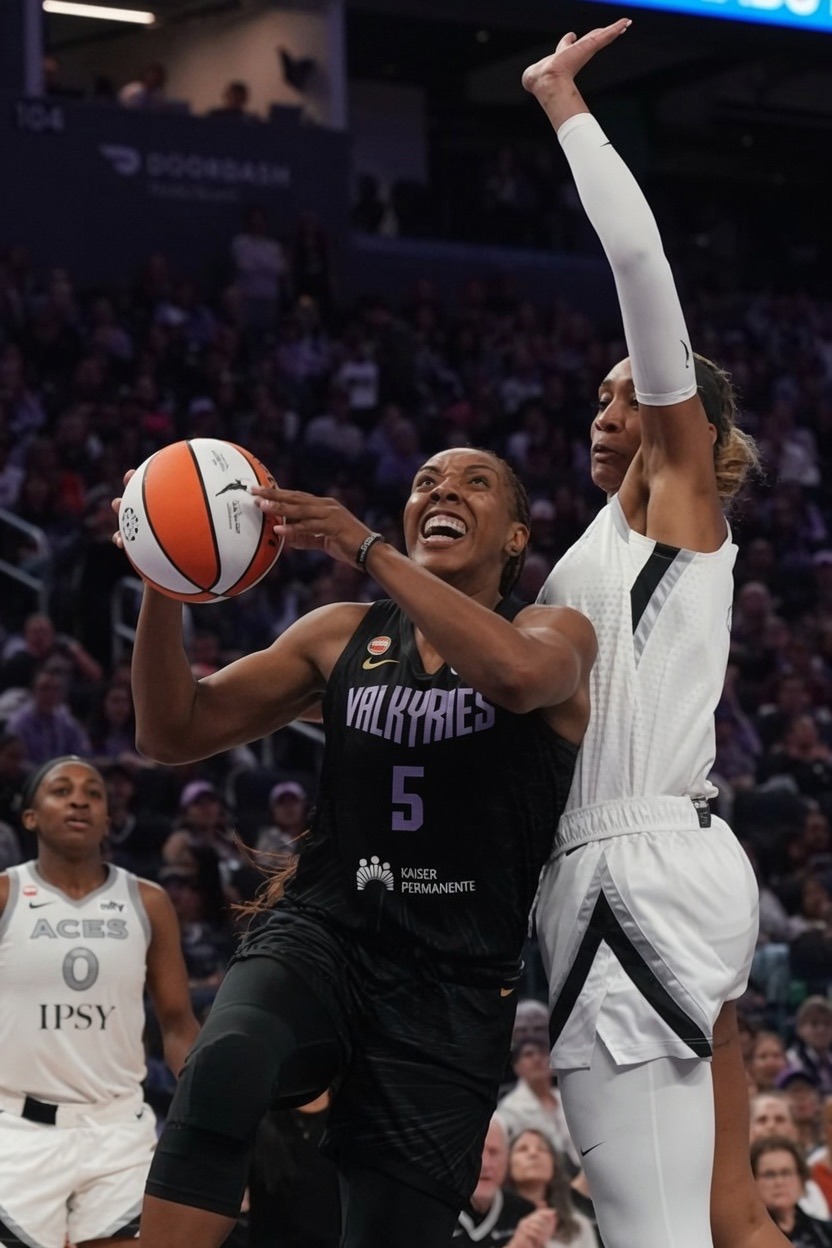
Golden State Valkyries forward Kayla Thornton (5) drives to the basket while guarded by Las Vegas Aces center A’ja Wilson (22) in the third quarter at Chase Center. (Photo: David Gonzales | Imagn Images)
SAN FRANCISCO — As the old saying goes: “In order to be the best, you have to beat the best” and by virtue of being the defending WNBA Champions (and winners of three of the last four WNBA Finals), the Las Vegas Aces represent the best of the best in the WNBA.
As such, the Golden State Valkyries had the opportunity to test themselves and gauge how they stack up against one of the projected 2026 title contenders when they hosted the Aces at Chase Center for Sunday’s matinee showcase game.
The final result, a 91-81 victory for the visiting team, did not quite reflect just how dominant Las Vegas’ performance was over Golden State. Despite a tightly-contested first quarter that saw the Valkyries take a two-point lead heading into the second frame, it never truly felt like Golden State controlled the pace or the flow of the game. With twelve lead changes and the game score being tied six times heading into halftime, this was one of the rare instances in the early going of the season in which the Valkyries failed to impose their will on their opponent.
“We can’t just rely on getting Ballhalla all excited in terms of our shooting,” Head Coach Natalie Nakase reminded her players after Golden State’s home loss to Chicago. Unfortunately for the Valkyries, that is exactly what happened on Sunday afternoon. The euphoria of Kayla Thornton’s back-to-back made three-pointers and Cecilia Zandalasini’s pull-up threes from way downtown masked the Valkyries’ inefficient and unbalanced first-half offense. Although the team shot a fairly robust 39.1% from 3P (9/23) in the first half, the Valkyries were held to 27.8% shooting (5/18) from inside the arc.
To be clear, the Valkyries entered halftime down two points largely because of how meticulous they were on defense. But when the team’s offense becomes one-dimensional by design (mainly due to the limitations of the roster’s personnel), the margin for error becomes increasingly slimmer as the game goes on. It is more than fair if Golden State’s defensive stalwarts Veronica Burton, Gabby Williams and Kayla Thornton are mentioned in conversations as one of the top defensive perimeter trios in the league. But even the elite perimeter defenses can break down when they are constantly having to scramble in transition after extended offensive lulls.
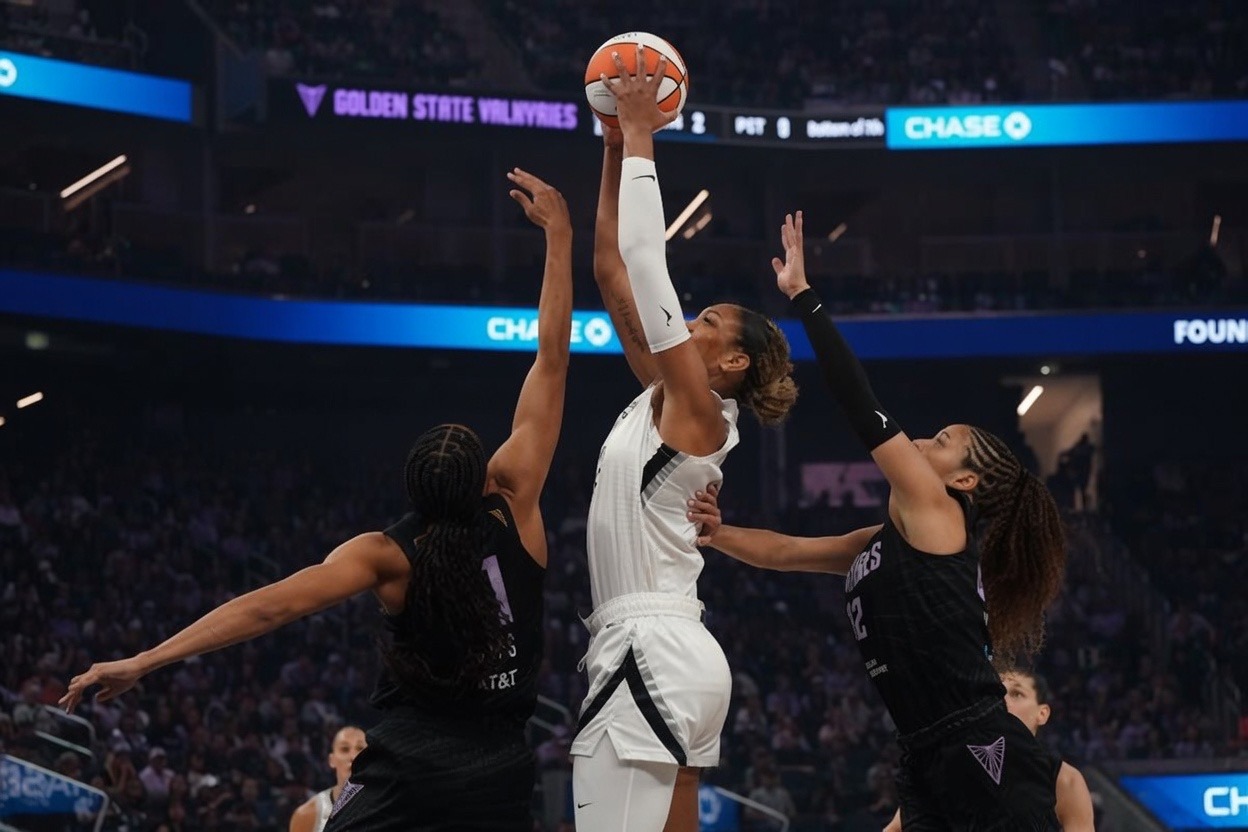
Las Vegas Aces center A’ja Wilson (22) grabs a rebound from Golden State Valkyries center Kiah Stokes (41) and guard Veronica Burton (22) in the first quarter at Chase Center. (Photo: David Gonzales | Imagn Images)
After the game, Thornton reflected on how the game got away from them in the third quarter.
“I think we’re a great team that attacks the paint,” said Thornton. “If you miss it, that’s okay, it’s onto the next thing, but like Gabby [Williams] said, we’re a defense-first team. So I think that’s what we have to get back to understanding, that’s how we want to win games.”
The first half highlighted what makes Golden State’s defense so special. With Kiah Stokes staying back in a low drop, the Valkyries had Williams stunt from the strong-side elbow to clog the paint and prevent dribble penetration. Anytime Aces guards Chelsea Gray or Jackie Young kicked out to the perimeter, Williams was able to use her speed and length to recover and contest the 3P-shooter. And in the instances where Williams was not in position to recover, her teammates rotated effortlessly on the perimeter and forced highly contested and off-balance shots.
The Valkyries’ defense was even more aggressive when Aces guard Chennedy Carter entered the game. Carter, an early favorite for Sixth Player of the Year, was double-teamed on every ball screen. Even if it was A’ja Wilson setting the high screen, the Valkyries elected to blitz the 5’9” Carter in order to dare her to pass over the top of the defense.
Early in the game, the Aces tried a similar defensive approach by having power forward/center NaLyssa Smith stay back in a low drop. Unlike the Valkyries, the Aces did not have a roamer to tag the roller, thus forcing Smith to have to step up and account for her initial defensive assignment. This led to a few opportunities for Burton and Williams to attack the rim which fueled Golden State’s early, albeit temporary, momentum.
By the second quarter, the Aces began to mix up their defensive coverages from possession to possession. When the Valkyries went to their small-ball 5-out lineup, the Aces actively switched late in the shot clock. Even if the Aces conceded a speed and/or lateral quickness mismatch on the late switches, the Valkyries did not have enough time to drive and fully take advantage of the matchup. Although their feet were set on their catch-and-shoot opportunities, the Valkyries ultimately shot over length on those late Aces closeouts.
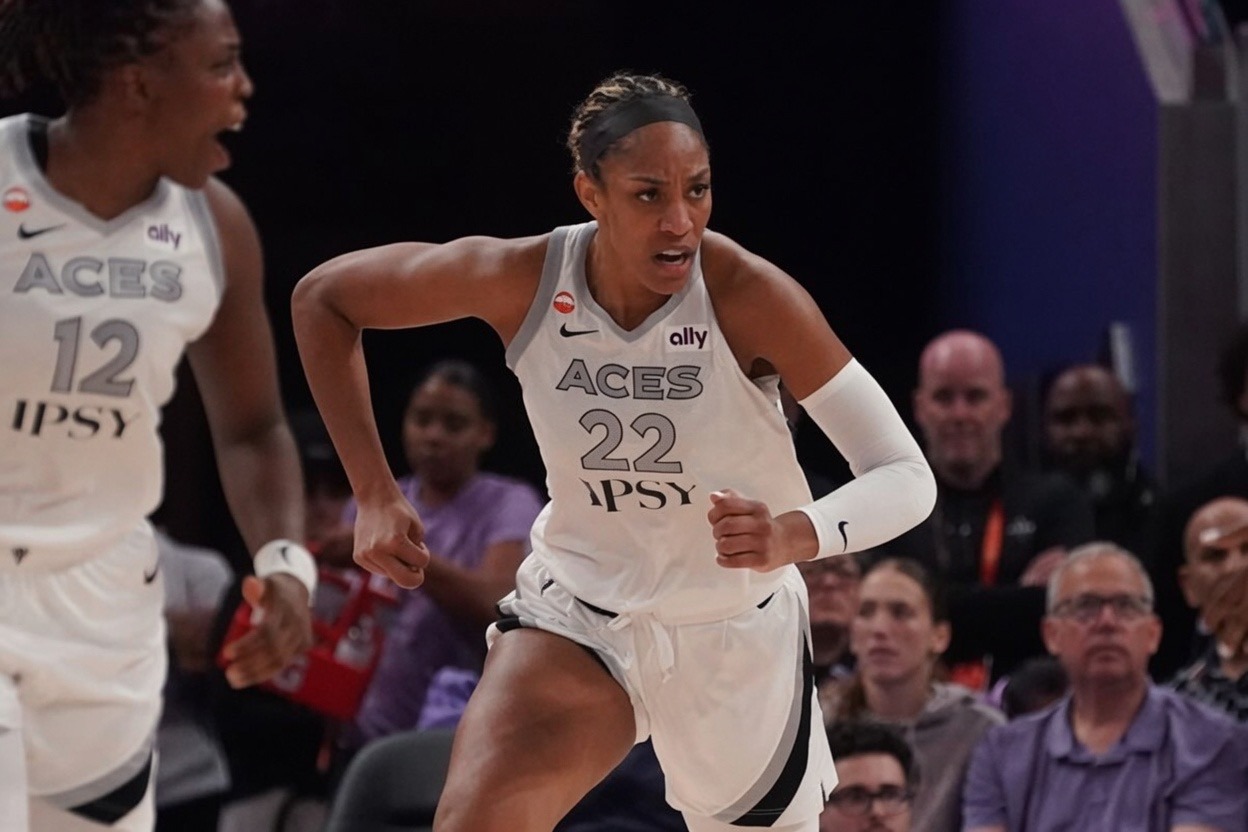
Las Vegas Aces center A’ja Wilson (22) and guard Chelsea Gray (12) run back on defense after a score against the Golden State Valkyries in the third quarter at Chase Center. (Photo: David Gonzales | Imagn Images)
Things did not get any easier for Golden State after halftime. Throughout the third quarter, Wilson, the reigning Co-Defensive Player of the Year, was constantly telling her teammates when and where to switch off the ball. By initially moving Wilson away from the basket early in the shot clock on defensive possessions, the Aces were able to use Wilson as the off-ball defender who could swap assignments in either the post or on the wing on these scram switches. And when Golden State tried to reinsert size into the lineup, Wilson completely sagged off Stokes and Laeticia Amihere on the perimeter, thus serving as a cheat code second-line defender.
After a 13-point third quarter on 17.6% shooting from the field (3/17) with six turnovers, the Valkyries succumbed to the Aces’ defensive tenacity.
With mounting offensive stagnation, Golden State was faced with even more pressure to lock down the defending champions on the defensive end. But Wilson, a four-time WNBA MVP, is blessed with both athletic gifts and a high basketball IQ. Ever since the Aces’ first meeting with the Valkyries in the 2025 season, Wilson has found a multitude of ways to counter the Valkyries’ digs and late help defense on her post-ups. Likewise, Wilson has practically nullified Golden State’s attempts to hedge and switch late on high pick-and-rolls that directly involve her.
“I think I just kind of see it a little sooner,” said Wilson when contemplating how she approaches Golden State’s late double-teams. “In this game plan, I have to play in space but also realize where the double is coming from, where is the help coming from.
“When you’re playing against a Valkyries team, they’re going to pack the paint. It’s going to be very, very hard to get your first option in the paint. So, once I kind of have that in my mind, my biggest thing is just making sure I’m looking for the next person, who’s the open person and how we can go from there. So, I think I just kind of realized that, you know, the ball can’t stick in my hands. I have to push it, I have to kick it and then we go from there.”
Including Sunday’s performance (28 points, 15 rebounds, four assists, one steal and four blocks), Wilson is averaging 23.8 points, 11.2 rebounds, and 3.0 assists in five career games versus the Golden State Valkyries. When Wilson does her work early and gets a deep seal, the Valkyries do not have the size down low to stop her from finishing up, over, or around Golden State’s backline defender.
If the Valkyries can bump her off the block, Wilson can comfortably face up, and stick a midrange jumper. And if you blitz her like the Valkyries attempted to do in the second half of Sunday’s game, she will fire off a layered pass to Stephanie Talbot cutting baseline or hit Smith in stride as she is ducking in down the lane for a point-blank layup.
It would be easy to chalk this loss up to the fact that there is only one Wilson, she is the best player in the world, and her teammates (such as Gray, Young, and Smith) not only complement Wilson’s skill set but also amplify it. This is all factually true, but Williams believed this loss was the result of an incorrect approach to the matchup.
“We let our offense dictate our defense again, instead of our defense dictating our offense,” said Williams after scoring a season-high 20 points. “We were relying on scoring versus getting stops.”
Williams is not necessarily wrong, but her assessment ignores the reality that the Valkyries’ prolonged offensive struggles directly impact their ability to properly execute on the defensive end. A string of consecutive missed field goals (especially missed 3-pointers) often results in long rebounds for the opponent; long defensive rebounds usually ignite fast break scoring opportunities.

Golden State Valkyries forward Gabby Williams (1) defended by Las Vegas Aces guard Chelsea Gray (12) at Chase Center. (Photo: Lucina M)
Despite playing a double-big lineup (Wilson and Smith), the Aces lead the league in pace (83.2). Given that their frontcourt can outpace even elite transition defenses, it is no surprise that the Aces average the second-most points in the paint (51.4 points in the paint per game).
When you take all of this into consideration, it is fair for Ballhalla to wonder whether the Valkyries ever stood a chance in this matchup playing their brand of small ball. Even when Golden State goes with their true 5-out lineup (Burton, Kaila Charles, Williams, Janelle Salaün and Thornton), the Valkyries still play at the fifth-slowest pace in the league (77.9). In other words, against the Aces’ starting lineup, the Valkyries best small-ball unit is significantly smaller and slower.
The Valkyries are currently fifth in the league in offensive rating (110.1) largely due to leading the league in two categories: 1) their ability to score efficiently from beyond the arc (40.2% of their total points come from 3-pointers) and 2) their ability to take care of the ball (11.3% turnover rate). However, Golden State ranks 13th in fast break points, 10th in free throws and 10th in points off turnovers. For a team that plays extended stretches using small-ball lineups, it is almost baffling that the Valkyries are not generating more rim pressure and quick points in transition.
After the game, Nakase once again held herself accountable for the loss.
“It starts with my leadership, and what I’m saying to them,” said Nakase. “It’s how I’m correcting them. So it starts with me. I got to correct my message. I got to deliver better. I have to be better, because they’re only going to go based off of the messages that I’m sending.”
Moving forward, Nakase has to make it clear what exactly her message is to the team. Unlike fans, the players will not spend time bemoaning the fact that they are undersized or dwell on a trade for a center that may never happen. If they are committed to this roster, then they have to not only embrace their small-ball identity, but also completely lean into it. And in order to do that, Nakase may need to go with her five best players who are all capable of dribbling, passing and shooting. Perhaps the first step is giving rookie and pick-and-roll maestro Justė Jocytė more run alongside Burton, Williams, Salaün and Thornton.
For the Golden State Valkyries, playing a game against the reigning WNBA Champions is akin to playing a hand of high-stakes Texas Hold’em poker. In order to increase your odds of winning, you may have to initially take a calculated risk before the flop. For the Valkyries, that risk might be having to slightly compromise their defense in order to tap into Jocytė’s offensive dynamism.
At the end of the day, Nakase’s system thrives on connectivity that is rooted in balance. That balance needs to extend equally to the offensive end as well as the defensive end. With a rematch against the Aces set six days after Sunday’s loss (June 6), it is imperative that Nakase and the Valkyries make the necessary adjustments to achieve their desired level of balance. But as long as the Valkyries stick to the status quo, they will likely hear the same thing the dealer at the casino says 99.9% of the time: Quad Aces are Good.